
Location: AC.2.B.2.3.8
Billy Joe made the transition from a successful professional playing career to becoming one the most highly decorated black college football coaches in history. After two seasons as an assistant coach he got his first head coaching job at Cheyney State in 1972. He had a winning club that first season and stayed with the Wolves for six more years. Joe then honed his skills with two years as an assistant in the NFL before taking the head job at Central State (OH). There he turned the Marauders into a national black college power. In 13 years at CSU he had six seasons where he lost only one game. His second team made it to the NCAA Division II finals, the first of 11 consecutive playoff teams. In both 1990 and 1992 his teams won the NAIA national championship. In 1994, he moved to Florida A&M. Joe quickly built this program as well. His second team won a league title while his third went to the first of six straight playoff appearances with his 1999 team advancing to the national semi-finals. On the Black College level he won six national championships and is second only to Eddie Robinson on the all-time black coaching win list. Greatly respected by his peers, he served the American Football Coaches Association as both president and vice president.
https://footballfoundation.org/honors/hall-of-fame/billy-joe/2191
Location: AC.3.A.1.5.3
Location: AC.3.A.1.7.1
Location: AC.3.A.3.2.3
Location: AC.3.A.3.3.5 - AC.3.A.3.4.2
Dr. Rupert Grant Seals (born 1932) is a distinguished educator, agricultural scientist, and academic leader known for his groundbreaking achievements in higher education. A graduate of Florida A&M University (1953), he became the first African American to earn a master’s degree from the University of Kentucky College of Agriculture in 1956 and later one of the first African Americans to earn a Ph.D. in animal sciences from Washington State University in 1960.
Throughout his career, Dr. Seals served as a professor and administrator at multiple institutions, including Florida A&M University, where he was dean of the School of Agriculture and Home Economics from 1969 to 1974. He also served as associate dean of the College of Agriculture at the University of Nevada. His work focused on agricultural science, education, and addressing disparities in Black academic agriculture.
Dr. Seals authored numerous scholarly works and received several honors, including the Thornton Peace Prize and induction into the University of Kentucky’s Hall of Distinguished Alumni. His legacy reflects a lifelong commitment to education, research, and expanding opportunities in agriculture for future generations. https://nkaa.uky.edu/nkaa/items/show/3173
Location: AC.3.A.3.6.1 - AC.3.A.3.6.2
Location: AC.3.A.3.6.4
Dr. William Spencer Stevens practiced medicine in Quincy for more than 50 years. His fame spread during the yellow fever outbreak of 1906 and the influenza epidemic of 1918.
https://www.tampabay.com/archive/1994/02/07/the-florida-black-heritage-trail/
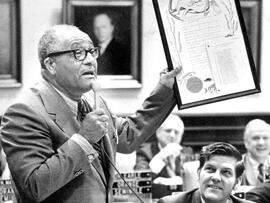
Location: AC.8.B.1.1.1-AC.8.B.1.1.3
Joseph “Joe” Lang Kershaw, Sr. (June 27, 1911–November 7, 1999) was the first African American elected to the Florida Legislature since Reconstruction. Born in Live Oak, Florida, he attended Florida A&M University in the 1930s, where he was involved in early campus life, including the beginnings of the football program, and pledged Kappa Alpha Psi. He later worked as a teacher in Miami-Dade County and as a janitor in the Florida Legislature before entering politics. Elected to the Florida House of Representatives in 1968, Kershaw served for fourteen years and chaired the Elections Committee, contributing to the establishment of the Florida Human Rights Commission.
The Joseph Lang Kershaw, Sr. Collection documents Kershaw’s life, career, and contributions to Florida’s political and educational history. The collection contains materials related to his personal and academic background, as well as records reflecting his tenure in the Florida House of Representatives.
Included are documents that highlight his legislative work, professional activities, and community involvement. The collection also contains materials pertaining to his family, including references to his father, A. J. Kershaw, as well as correspondence and documents related to colleagues and contemporaries such as Gwendolyn Cherry and Althea Gibson. Collectively, these records provide insight into Kershaw’s role as a pioneering African American legislator and his broader impact on civil rights and public service in Florida.
Location: R.4.A.4.1.1
The FAMU Hospital first started in 1911 as a sanitorium supervised by Nurse Virginia Hilyer. For many years this clinic served the student population and when an annex was added to the hospital in 1922 services were opened to the larger Tallahassee community, with services provided by doctors from all over the city to all ethnicities. African American physicians in Tallahassee also served at the hospital including, Drs. William G. Gunn, Alpha Omega Campbell, and L.H.B. Foote.
It was under L. H. B. Foote's directorship that the first annual Medical Clinic was hosted on campus in 1926. The Medical Clinic was created to host informational presentations and networking between medical professionals and education groups and later fused with Florida A&M Clinical Association. The clinical association's focus on sharing knowledge, resources, and training opportunities to medical professionals throughout Florida, Georgia, and Alabama added to the overall goal of getting modern medical care to Black patients.
The 1930s saw several initiatives blooming at the campus hospital; continued expansions to the hospital, the campaign to add a nursing training facility, and partnerships with the Florida State Board of Health to host midwife training workshops all created an air of growth, advancement, and modernity. It took twenty ear and two university presidents (J.R.E. Lee and George W. Gore) to establish the full hospital and nurse training unit on the basis of the already existing hospital that would serve African Americans from Tallahassee and surrounding counties.
It took federal grants, support from the Tallahassee City Commission, and a capital campaign that included donations from various civic leagues and from a stymied effort to build a Black hospital in Jacksonville to gather the $2,000,000 needed for the facility but finally it was done. The grand opening was opening liberally celebrated.
Through the 1960s, the FAMU Hospital continued to serve the community but advancements in civil rights for African Americans had a surprising adverse affect--in the effort to integrate both Tallahassee Memorial Hospital and FAMU Hospital both institutions were issued orders to integrate, which should not have been a problem for FAMU Hospital since it had always employed both Black and White doctors and been open to all patients. However, withdrawal of state and federal financial support for the hospital and accusations of mismanagement of funds began to compromise it's efficacy and by the end of the decade plans were already in motion for its closure. The hospital officially closed in 1971 and in 1981 the building housing the hospital was remodeled and rededicated as the Foote-Hilyer Administration Building, containing the University's administrative offices and Student Health Services.
This collection comprises primarily correspondence, reports, and publications of the FAMU Hospital Fund Committee--tasked with raising and organizing funds for the hospital expansion of 1951, and administrative records of the Hospital Advisory Board--tasked with governing the FAMU Hospital during its existence from 1951 to 1971. Much of the correspondence is to or from Dr. George W. Gore, FAMU's eighth University President. Other figures of note are then-Senator Leroy Collins, who served as the Chairman of the Advisory Board; Dr. LH.B. Foote who also served on the Hospital Advisory Board. Other organizations and offices whose activities are recorded in this collection are FAMU Clinical Association; the Board of Regents; the Board of Control; Leon County; and the City of Tallahassee as it relates to the establishment, management, and dissolution of the FAMU Hospital.
Some of the significant topics represented in these files are the complexities of desegregation and integration; Black hospital management; public health; nurse training and education; professional development; fundraising.
Items were arranged in series by type of communication object, sorted into folders chronologically, and each series arranged alphabetically. Attachments are listed alphanumerically starting with the item number of the document they were originally attached to. All hardware was removed and documents sleeved. Some documents will require flattening, cleaning, and other conservation efforts.