MS_0086
Location: AC.3.A.3.1.4 - AC.3.A.3.2.2

Location: AC.3.A.3.1.4 - AC.3.A.3.2.2
Location: AC.3.A.3.3.1 - AC.3.A.3.3.2
Location: AC.3.B.1.1.5 - AC.3.B.1.2.1
The A. P. Turner collection is a two-box collection that documents the life of Allen P. Turner, a reverend of the Bethel Missionary Baptist Church and a Morehouse College graduate who wrote and directed dramatic plays at Albany State College and Florida A&M University.
The items within this collection date from 1930 to 1972, and are concentrated between 1940 and 1968. This collection includes academic and business papers, playscripts, letters, and other printed materials that provide valuable insight into Turner’s professional and personal life. His involvement in the Interdenominational Ministers Alliance of Tallahassee and Vicinity, the Young Men’s Christian Association, and the Florida Inter-Scholastic Speech and Drama Association gives this collection a strong representation of his religious, scholarly, and artistic leadership. Although the collection offers a strong foundation for understanding Turner’s leadership within religious and scholarly organizations, many items are untitled and undated, limiting the ability to fully contextualize specific individuals, events, and materials. Overall, the A. P. Turner collection provides valuable documentation of Turner’s life and how his social status as a reverend, playwright, and director contributed to his community.
Location: AC.3.B.1.3.4
Dr. Victoria Efferson Warner (1927–2006) was a distinguished professor at Florida A&M University, where she made lasting contributions to education and student development, particularly in social work. Over the course of her career, she was known for her dedication to mentorship, academic excellence, and service to the university community.
In honor of her legacy, the Dr. Victoria E. Warner Scholarship Fund was established to support students in FAMU’s School of Social Work. She is remembered for her impact as an educator, her commitment to uplifting others, and her strong family and community ties.
Location: AC.3.B.1.5.3 - AC.3.B.1.5.5
Location: AC.1.B.2.1.1 - AC.1.B.2.1.6
Asa Philip Randolph (1889–1979) was a pioneering labor leader and civil rights activist who played a major role in advancing equality for African Americans. Born in Florida, he organized the Brotherhood of Sleeping Car Porters in 1925, the first successful Black-led labor union, and became a leading voice for workers’ rights and racial justice.
Randolph helped pressure the federal government to end discrimination in defense industries during World War II and was a key organizer of the 1963 March on Washington, where Dr. Martin Luther King Jr. delivered his famous “I Have a Dream” speech. His lifelong commitment to nonviolent protest, labor rights, and civil rights made him one of the most influential leaders of the 20th century.
For more than 130 years, Florida A&M University has served the citizens of the State of Florida and the nation by providing preeminent educational programs...programs that were the building blocks of a legacy of academic excellence with caring. FAMU, “Florida’s Opportunity University,” is committed to meeting the challenges and needs of future generations.
In 1884, Thomas Van Renssaler Gibbs, a Duval County educator, was elected to the Florida legislature. Although his political career ended abruptly because of the resurgence of segregation, Representative Gibbs successfully orchestrated the passage of House Bill 133 in 1884. This bill established a white normal school in Gainesville and a school for African Americans in Jacksonville. The bill passed, creating both institutions; however, the state decided to relocate the school for African Americans to Tallahassee.
After the bill’s passage, FAMU was founded on October 3, 1887. It began classes with 15 students and two (2) instructors. Thomas DeSaille Tucker (1887-1901), an attorney from Pensacola, was chosen as the first president. Former State Representative Gibbs joined Mr. Tucker as the second faculty member.
In 1891, the College received $7,500 under the Second Morrill Act for agricultural and mechanical arts education. The State Normal College for Colored Students became Florida’s land grant institution for African Americans, and its name was changed to the State Normal and Industrial College for Colored Students.
In 1905, the management of the College was transferred from the Board of Education to the Board of Control. This significant event officially designated the College as an institution of higher education.
In 1909 the name was changed from The State Normal College for Colored Students to Florida Agricultural and Mechanical College for Negroes (FAMC). The following year, with an enrollment of 317 students, the college awarded its first degrees.
President Nathan B. Young (1901-1923) directed the growth of the College to a four-year degree-granting institution, despite limited resources, offering the Bachelor of Science degree in education, science, home economics, agriculture, and mechanical arts.
Under the administration of John Robert Edward Lee Sr. (1924-1944), the College acquired much of the physical and academic image it has today. More faculty were hired, courses were upgraded, and accreditation was received from several state agencies. By the end of Lee’s term, FAMC had 812 students and 122 staff members.
In 1949, under William H. Gray Jr. (1944-1949), expansion and reorganization continued. The College obtained an Army ROTC unit, and student enrollment grew to more than 2,000.
Location: AC.2.B.2.3.2 - AC.2.B.2.3.5
Reverend Dr. James L. Hudson, Sr. (1904–1980) was a minister, educator, and civil rights leader. Born in Birmingham, Alabama, he graduated from Morehouse College in 1926 and later earned a divinity degree from Colgate-Rochester School of Religion in 1931. He served as a chaplain at Leland College until 1946 before completing doctoral studies at Boston College. Dr. Hudson later joined Florida A&M University as a chaplain and professor, where he founded the Department of Religion and Philosophy and served as its first chair. A close associate of Rev. Charles K. Steele, he played a key role in civil rights efforts, including the 1956 Tallahassee Bus Boycott, and was active in organizations such as the Tallahassee Ministerial Alliance and the Inter-Civic Council.
The Reverend Dr. James Hudson, Sr. Collection documents Hudson’s career in ministry, education, and civil rights activism. The collection contains materials related to his work at Florida A&M University, including records associated with the establishment of the Department of Religion and Philosophy, as well as documents reflecting his role as a chaplain and educator.
Additional materials highlight his involvement in civil rights initiatives in Tallahassee, including his collaboration with local religious and community leaders. The collection may include correspondence, sermons, speeches, and organizational records that illustrate his leadership in religious and civic life. Collectively, these materials provide insight into Hudson’s lasting contributions to higher education, faith leadership, and the advancement of social justice.
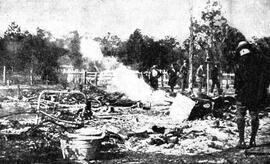
Location: AC.6.B.2.4.7-AC.6.B.3.4.4
The Rosewood Massacre was a racially motivated attack on the predominantly African American town of Rosewood, Florida, in January 1923. Sparked by false accusations and fueled by racial tensions under Jim Crow segregation, white mobs destroyed homes, churches, and businesses, forcing residents to flee and permanently abandon the town. For decades, the event remained largely suppressed in public memory until renewed attention in 1982 by journalist Gary Moore prompted survivors and descendants to seek justice. Their efforts led to a state investigation and compensation legislation, marking one of the first instances of reparations for racial violence in the United States.
Archival Description:
The Rosewood Massacre Papers Collection spans 35 boxes with materials dating from 1900 to 1996 and documents the historical, legal, and commemorative efforts surrounding the 1923 massacre. The collection includes narrative reports, multiple versions of documented histories, survivor affidavits, administrative files, correspondence, interview transcripts, handwritten notes, vital records such as birth certificates, census records including the 1920 U.S. Census, property records such as Levy County deed indexes, and materials related to claims verification.
Folders within the collection contain complete narrative reports and reproduced copies used for research, review, and preservation; affidavits from survivors including Bertha Fagin, Ivory T. Fuller, Vera G. Goins Hamilton, Thelma Hawkins, and Dorothy G. Hosey; correspondence from agencies such as the Florida State Department of Health and Rehabilitative Services and Offices of Vital Statistics; as well as administrative communications, genealogical documentation, and evidentiary records supporting compensation claims.
Collectively, these materials document both the historical reconstruction of the Rosewood Massacre and the legal and administrative processes undertaken to verify survivors, establish lineage, and secure restitution.
The Florida A&M University Hospital Collection documents the establishment, development, and administration of the Florida A&M College (FAMC) Hospital, later known as the Florida A&M University (FAMU) Hospital. Spanning the mid-twentieth century, this collection provides insight into the critical role the hospital played in serving the African American community during the era of segregation, when access to quality healthcare for Black patients was severely limited in the South.
The materials within this collection highlight the planning and funding efforts that led to the hospital’s creation, including correspondence, financial records, and reports related to state appropriations, community support, and institutional advocacy. Documentation of the building and expansion of the hospital illustrates the physical and infrastructural development of the facility, reflecting broader efforts to improve healthcare access and medical education opportunities for African Americans in Florida.
Additionally, the collection contains administrative records that detail the hospital’s operations, governance, and staff organization. These records may include internal memoranda, policy documents, personnel files, and reports that provide insight into the day-to-day management of the institution. Collectively, these materials offer valuable historical context on the intersection of healthcare, education, and racial inequality, and demonstrate the significance of FAMU Hospital as both a medical facility and a training ground for African American healthcare professionals.