MS_0089
Location: AC.3.A.3.3.1 - AC.3.A.3.3.2

Location: AC.3.A.3.3.1 - AC.3.A.3.3.2
Location: AC.3.A.3.3.4
Location: AC.3.B.1.3.2
Location: AC.3.B.1.3.4
Dr. Victoria Efferson Warner (1927–2006) was a distinguished professor at Florida A&M University, where she made lasting contributions to education and student development, particularly in social work. Over the course of her career, she was known for her dedication to mentorship, academic excellence, and service to the university community.
In honor of her legacy, the Dr. Victoria E. Warner Scholarship Fund was established to support students in FAMU’s School of Social Work. She is remembered for her impact as an educator, her commitment to uplifting others, and her strong family and community ties.
Location: AC.3.B.1.5.7
Charles Winter Wood (1869–1953) was an accomplished educator, actor, and pioneer in African American theatre and higher education. Born in Nashville, Tennessee, he became one of the first Black graduates of Beloit College and later earned advanced degrees from Chicago Theological Seminary and Columbia University.
Wood spent over 30 years teaching at Tuskegee Institute, where he led the English and drama departments and also served as a football coach. He later joined Florida A&M University as a teacher of dramatic arts, helping to develop its theatre program.
In addition to his academic work, Wood was a successful stage actor, notably performing in the Broadway production The Green Pastures. His career reflects a lasting legacy in education, theatre, and the advancement of Black cultural expression.
For more than 130 years, Florida A&M University has served the citizens of the State of Florida and the nation by providing preeminent educational programs...programs that were the building blocks of a legacy of academic excellence with caring. FAMU, “Florida’s Opportunity University,” is committed to meeting the challenges and needs of future generations.
In 1884, Thomas Van Renssaler Gibbs, a Duval County educator, was elected to the Florida legislature. Although his political career ended abruptly because of the resurgence of segregation, Representative Gibbs successfully orchestrated the passage of House Bill 133 in 1884. This bill established a white normal school in Gainesville and a school for African Americans in Jacksonville. The bill passed, creating both institutions; however, the state decided to relocate the school for African Americans to Tallahassee.
After the bill’s passage, FAMU was founded on October 3, 1887. It began classes with 15 students and two (2) instructors. Thomas DeSaille Tucker (1887-1901), an attorney from Pensacola, was chosen as the first president. Former State Representative Gibbs joined Mr. Tucker as the second faculty member.
In 1891, the College received $7,500 under the Second Morrill Act for agricultural and mechanical arts education. The State Normal College for Colored Students became Florida’s land grant institution for African Americans, and its name was changed to the State Normal and Industrial College for Colored Students.
In 1905, the management of the College was transferred from the Board of Education to the Board of Control. This significant event officially designated the College as an institution of higher education.
In 1909 the name was changed from The State Normal College for Colored Students to Florida Agricultural and Mechanical College for Negroes (FAMC). The following year, with an enrollment of 317 students, the college awarded its first degrees.
President Nathan B. Young (1901-1923) directed the growth of the College to a four-year degree-granting institution, despite limited resources, offering the Bachelor of Science degree in education, science, home economics, agriculture, and mechanical arts.
Under the administration of John Robert Edward Lee Sr. (1924-1944), the College acquired much of the physical and academic image it has today. More faculty were hired, courses were upgraded, and accreditation was received from several state agencies. By the end of Lee’s term, FAMC had 812 students and 122 staff members.
In 1949, under William H. Gray Jr. (1944-1949), expansion and reorganization continued. The College obtained an Army ROTC unit, and student enrollment grew to more than 2,000.
Location: AC.2.A.1.6.3 - AC.2.A.2.3.1; AC.3.B.3.3.1 - AC.3.B.3.3.2; AC.8.B.1.2.3 - AC.8.B.1.3.2
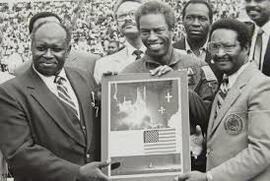
In 1975, James N. Eaton spearheaded the effort that ultimately gave rise to the creation of FAMU’s Black Archives. By 1976, the ‘Black Archives Research Center and Museum’ came into existence, and Eaton was recognized and appointed as its inaugural archivist, curator, and director.
For the next three decades, he helped amass a collection of memorabilia and printed records that now comprise one of the region’s most extensive collections of first-source material relating to the history, culture and contributions of people of African descent living in the United States.
James Eaton constructed in 1976 the first exhibits, using historical memorabilia from his own family. Afterward, he petitioned the university and community members to contribute historical material to the repository. Ilis call was answered by the first Black Archives donors and volunteers, who included: Donald Hill, Frank Pinder, John F. Matheus, and a host of other individuals and groups. Thus, the Research Center was chartered in 1976 and was officially opened in 1977.
Location: AC.8.B.2.4.3
Mr. Charles Hamilton was an African-American landowner, farmer, and businessman who lived
in Marion County, Florida, during the late 1800s and turn of the twentieth century. Marion
The county is located in Central Florida. According to information from the 1900 US Census, the
Hamilton Family patriarch, listed as Charly Hamilton, was born during slavery in 1853 and
possibly migrated to Florida from South Carolina after the Civil War. Charly and his wife
Georgia had three sons, Richard, Charlie, and Jonas, and two daughters, Estelle and Texella.
Hamilton and his descendants also owned property and conducted business in neighboring Levy
County.
Location: AC.2.B.3.2.2- AC.2.B.3.2.5
This collection consists of personal papers from Florida A&M University’s Arthur L. Kidd. Kidd, a native of Pennsylvania, earned a B.A. degree in 1924 from the University of Michigan, and in 1929, a Masters of Arts degree from Columbia University. Kidd also did additional studying at the University of Iowa, Columbia University, and New York University. He began his teaching career at Tuskegee Institute in 1924 before accepting a position at Florida A&M College (FAMCEE) in 1925 as Principal of the High School. Kidd worked at FAMCEE until 1944. During his nineteen years of service to the college, Kidd worked in numerous positions, including: Head of the Department of History, Acting Director of the Extension Division, Acting Dean for the College of Arts and Sciences and College Registrar. In October 1944, Kidd left his position at FAMCEE to work with the United Nations Relief and Rehabilitation Administration, where he worked in various capacities in Washington, D.C., and abroad in locations including France, Germany, and Holland. He returned to the United States in 1950 and worked for a year at Maryland State College before accepting a second appointment at FAMCEE in 1951 as Director of the Division of Social Studies. Upon the college reaching university status in 1954, in the academic re-organization, Kidd consequently became the Associate Dean of the College of Arts and Sciences. Until 1969, he served FAMU in various capacities, including director of institutional studies and director of university administrative planning.
The material type in this collection were mainly magazines, news articles, and news clippings from 1949-19687 that followed local and national events affecting Negro people and occurrences impacting their lives. The records of this collection are especially important and informative in that they as resources that document firsthand the many historic events that occurred during the American Negro Civil Rights Years. Most of the records document the passing of school integration and public desegregation legislation, mass boycotts, sit-ins, and other forms of protest, as well as the brutal, nationwide social turbulence that accompanied this period. Additionally, a small amount of materials related to Kidd's instructional duties at FAMU are included.
Biographical data and inclusive subjects were acquired from Murell Dawson circa 2002.
Location: AC.8.B.1.1.1-AC.8.B.1.1.3
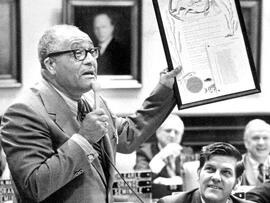
Joseph “Joe” Lang Kershaw, Sr. (June 27, 1911–November 7, 1999) was the first African American elected to the Florida Legislature since Reconstruction. Born in Live Oak, Florida, he attended Florida A&M University in the 1930s, where he was involved in early campus life, including the beginnings of the football program, and pledged Kappa Alpha Psi. He later worked as a teacher in Miami-Dade County and as a janitor in the Florida Legislature before entering politics. Elected to the Florida House of Representatives in 1968, Kershaw served for fourteen years and chaired the Elections Committee, contributing to the establishment of the Florida Human Rights Commission.
The Joseph Lang Kershaw, Sr. Collection documents Kershaw’s life, career, and contributions to Florida’s political and educational history. The collection contains materials related to his personal and academic background, as well as records reflecting his tenure in the Florida House of Representatives.
Included are documents that highlight his legislative work, professional activities, and community involvement. The collection also contains materials pertaining to his family, including references to his father, A. J. Kershaw, as well as correspondence and documents related to colleagues and contemporaries such as Gwendolyn Cherry and Althea Gibson. Collectively, these records provide insight into Kershaw’s role as a pioneering African American legislator and his broader impact on civil rights and public service in Florida.