MS_0078
Location: AC.3.A.1.5.3

Location: AC.3.A.1.5.3
Location: AC.3.A.1.5.5
Dr. Paul B. Mohr Sr. was a respected educator, academic leader, and pioneer in higher education who made significant contributions to Florida A&M University and the broader academic community. After earning his doctorate from Oklahoma State University, he served as dean of the School of Education at Florida A&M University, where he helped strengthen both undergraduate and graduate programs.
Earlier in his career, Dr. Mohr was a mathematics teacher and later became one of the founding professors and administrators at Gibbs Junior College, playing a key role in expanding educational opportunities for African American students. His legacy is marked by his commitment to academic excellence, leadership, and the advancement of education.
Location: AC.3.B.3.2.3
Location: AC.3.A.3.4.3 - AC.3.A.3.5.2
Dr. Charles Ullman Smith (1926–2015) was a distinguished sociologist, educator, and civil rights leader who spent nearly five decades at Florida A&M University. He earned his Ph.D. in sociology from Washington State University, becoming one of the first African Americans to achieve this distinction at the time.
During his career at FAMU, Smith served as chairman of the Department of Sociology, director of graduate studies, and dean of graduate studies, while also publishing numerous scholarly works. Beyond academia, he was an active participant in the Civil Rights Movement, including involvement in the 1956 Tallahassee Bus Boycott and the 1960 sit-ins.
Dr. Smith’s legacy reflects a lifelong commitment to education, social justice, and community leadership, making him a key figure in both higher education and the fight for civil rights in Florida.
https://floridacivilrightsmuseum.org/exhibition/they-made-a-difference-part-2/charles-u-smith-ph-d/
Location: AC.3.A.3.6.3
Location: AC.3.B.1.5.3 - AC.3.B.1.5.5
These objects, linked to a period of approximately 1870-1940, offer a glimpse into the subtle influence of colonial oversight. Field spirits were crafted to protect women and children, homes, crops, domestic animals, and providers (hunters) and also displayed warnings to those venturing onto protected lands, fields, homes, or pilfering from the property owner. The reliance on such objects indicates that longstanding conversion to Christianity among the Fante did not replace traditional beliefs about the security of homes, crops, domestic animals, and people.
These examples of field spirits are rare because they were tools, not created to be objects of art, but crafted to offer specific protection and security for the people who placed them in the fields. Environmental exposure and insects, particularly termites, destroy wooden objects in West Africa very quickly. It is precisely because such field spirits were normally left in the fields that very few remain.
Sans titre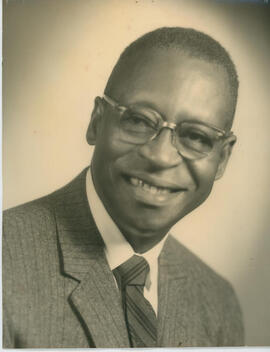
Location: AC.3.B.1.5.2
"The nation’s first Black junior college, Booker T. Washington Junior College, opened in Pensacola, Florida, in 1949 on the campus of all-black Booker T. Washington High School. The two institutions shared a name, a building, and an administrator: Dr. Garrett T. Wiggins.
Dr. Garrett T. Wiggins was, at the time, the only educator in all of northwest Florida with an earned doctorate, and he served as founding (and only) president and dean of the college and principal of the high school and was known as “the smartest man in the county.”
Before landing at Booker T. Washington, Wiggins served on the faculty at Florida A&M University. He’s remembered as “an educational catalyst, dedicated to the concept that black children must realize the importance of receiving an education.”
Booker T. Washington Junior College provided many Black students with a foundation to transfer into Bethune-Cookman College, Edward Waters College, and Florida A&M University with a solid foundation in teaching, medicine, law, and theology.
In 1965, Booker T. Washington “merged” with then Pensacola Junior College, and Wiggins went on to serve as Pensacola Junior College’s Director of Research until his retirement. However, many argue the school was effectively closed, as Pensacola Junior College did not make a great effort to include the Booker T. Washington’s students or faculty into the fabric of the institution.”
Location: AC.7.A.1.2.2 - AC.7.A.1.5.3
The Black Schools in Florida Collection documents the history, administration, and cultural life of African American education in Florida during the era of segregation and beyond. Comprising twelve boxes of materials, this collection provides rich insight into the development of Black primary and secondary schools, as well as the educators, administrators, and communities that sustained them. The records collectively highlight the structure of segregated schooling, the professional networks of Black educators, and the efforts toward institutional improvement and accreditation.
The collection consists of a wide range of materials, including correspondences, school records, conference records, and publications that reflect the daily operations and broader educational initiatives of Black schools throughout the state. Printed materials such as programs, event programs, yearbooks, newspapers, and school publications illustrate student life, extracurricular activities, and community engagement. Additional items, including certificates of membership, certificates of accreditation, high school diploma covers, plaques, and school emblems, provide evidence of institutional identity, achievement, and recognition.
Educational development and administrative practices are further represented through instructional materials and reports, including a self-study of Nims Middle School, an instructional book for Duval County middle schools, a junior high school handbook, and documentation related to teacher workshops and professional training. The collection also includes records such as a statewide list of Negro principals and materials pertaining to educators in Gadsden County, offering valuable context on leadership and staffing within Black educational institutions. Notably, one empty box labeled “Foreign Affairs” is present, suggesting either removed or relocated materials.
Photographs within the collection visually document school buildings, faculty, students, and events, complementing the textual records and enhancing the historical narrative. Together, these materials provide a comprehensive view of the educational experiences of African American students and educators in Florida, emphasizing both the challenges of segregation and the resilience and accomplishments of Black school communities.
Location: AC.2.B.3.5.1. - AC.2.B.3.5.2
Dr. LaSalle Doheny Leffall, Jr. (1930–2019) was a distinguished surgeon, oncologist, and medical educator born in Tallahassee and raised in Quincy. A prodigious student, he graduated from Florida A&M University at age 18 and earned his M.D. from Howard University College of Medicine by age 22. Leffall became a leading figure in surgical oncology, dedicating his career to cancer research and education, particularly focusing on disparities affecting African American communities. He served for 25 years as chairman of the Department of Surgery at Howard University, trained thousands of medical students, and held prominent leadership roles, including president of the American Cancer Society and the American College of Surgeons. https://www.thehistorymakers.org/biography/dr-lasalle-d-leffall-jr-38