
Location: AC.1.B.2.1.1 - AC.1.B.2.1.6
Asa Philip Randolph (1889–1979) was a pioneering labor leader and civil rights activist who played a major role in advancing equality for African Americans. Born in Florida, he organized the Brotherhood of Sleeping Car Porters in 1925, the first successful Black-led labor union, and became a leading voice for workers’ rights and racial justice.
Randolph helped pressure the federal government to end discrimination in defense industries during World War II and was a key organizer of the 1963 March on Washington, where Dr. Martin Luther King Jr. delivered his famous “I Have a Dream” speech. His lifelong commitment to nonviolent protest, labor rights, and civil rights made him one of the most influential leaders of the 20th century.
African American History
13 Archival description results for African American History
MS_0114
MS_0006
Location: AC.7.B.1.2.2 - AC.7.B.1.2.3
The Afro-American Life Insurance Company was a pioneering African American–owned business founded in 1901 in Jacksonville, Florida, by Abraham Lincoln Lewis and a group of associates. Established during a time of widespread racial discrimination and segregation in the United States, the company emerged in response to the limited access Black Americans had to essential financial services. Many mainstream insurance companies either denied coverage to Black individuals or offered policies at unaffordable rates, leaving Black communities without the financial protection that life insurance could provide.
In addition to offering life insurance policies, the Afro-American Life Insurance Company played a vital role as a financial institution within the African American community. It provided opportunities for economic stability through services such as mortgages and financial planning, helping to build wealth and security for families who were otherwise excluded from traditional banking systems. The company’s influence extended beyond finance; it was instrumental in the development of American Beach, a recreational resort established in 1935 as a safe and welcoming destination for Black Americans during the era of segregation.
Throughout the early and mid-20th century, the Afro-American Life Insurance Company stood as a symbol of Black entrepreneurship, resilience, and self-sufficiency. However, increasing competition from larger insurance companies in the latter half of the 20th century contributed to its eventual closure in 1990. Despite this, the company’s legacy endures as a significant example of African American economic empowerment and community development. The historic building that once housed the company at 101 East Union Street in Jacksonville has since been renovated and repurposed, continuing to serve the community in new ways. https://unfdhi.org/earthawhite/items/show/49
Meek-Eaton Archival Collection CO_0001-CO_0001_02_01-Box 01
·
1900 - 2017
Part of Meek-Eaton Southeastern Regional Black Archives Research Center and Museum Collection
The Black Entertainers collection (approx. early 1900s-2017), donated by Mildred S. Kershaw, is a one-box collection that highlights the legacy of Black Entertainment. This collection contains professional correspondence, newspaper articles, publications, miscellaneous objects, promotional photographs, and programs that document the profound history and culture of Black people. This
collection embodies the powerful themes of Black liberation, Black expression, Black representation, and Black ownership to demonstrate the strong control Black people have over their culture. The locations associated with this collection are: Tallahassee, Florida; Ocala, Florida; Charleston, West Virginia; Jacksonville, Florida; Chicago, Illinois; Washington, D.C.; New York, New York; Johannesburg, South Africa; and New Orleans, Louisiana. Although this collection has a strong foundation in documenting the history and culture of Black entertainment, many of its items are undated and unnamed, which limits the collection’s ability to accurately contextualize each item and folder.
Meek-Eaton Archival Collection CO_0001-CO_0001_02_01
·
Collection
·
Concentrated Dates 1968-1985
Part of Meek-Eaton Southeastern Regional Black Archives Research Center and Museum Collection
Location: AC.7.B.
The Black Entertainers Collection (approximately early 1900s–2017), donated by Mildred S. Kershaw, is a one-box collection that documents the legacy, cultural impact, and historical significance of Black entertainment across local, national, and international contexts. The materials within this collection reflect the breadth of Black artistic expression and professional achievement, highlighting themes of Black liberation, representation, ownership, and cultural preservation. Geographic locations associated with the collection include Tallahassee and Jacksonville, Florida; Ocala, Florida; Charleston, West Virginia; Chicago, Illinois; Washington, D.C.; New York, New York; New Orleans, Louisiana; and Johannesburg, South Africa, illustrating the widespread influence of Black entertainers and cultural production.
The collection consists of professional correspondence, newspaper articles, publications, promotional photographs, programs, and miscellaneous objects that collectively document the careers, public reception, and cultural contributions of Black entertainers. These materials provide insight into performance history, media representation, and community engagement, while also preserving evidence of the social and political contexts in which Black entertainers operated. Although the collection offers a strong foundation for understanding the history and evolution of Black entertainment, many items are undated and lack clear identification, which limits the ability to fully contextualize specific individuals, events, and materials.
Items within the collection are arranged in series according to the type of communication object they represent, such as correspondence, printed materials, and visual media. Within each series, materials are organized in alphanumeric order to maintain a consistent and accessible structure. Attachments associated with individual items are arranged chronologically by year to preserve original context and sequencing. All documents have been placed in protective sleeves and any original hardware has been removed to support long-term preservation.
Meek-Eaton Archival Collection MS_0016
·
Collection
·
1942 - 2017
Location: AC.8.B.1.6.2
This file documents the life, military service, and posthumous recognition of Chester Lee Davis, Sr., one of the pioneering African American Marines trained at Montford Point during World War II. Spanning the years 1942 to 2017, this collection provides valuable insight into both Davis’s individual experiences and the broader historical significance of African American service members who served under segregated conditions in the United States Marine Corps.
Chester Lee Davis, Sr. (1923–1981) was born in Quincy, Florida, to Tommie and Iola Davis and was raised in a large farming family. Prior to the outbreak of World War II, his family relocated to Orlando, Florida. In 1943, at the age of eighteen, Davis enlisted in the United States Marine Corps, becoming part of the first generation of African American Marines admitted into service. Due to racial segregation, he trained at Montford Point Camp in North Carolina, a facility established specifically for Black Marines and located near Camp Lejeune, where white Marines trained. Despite facing systemic discrimination and harsh conditions, Davis served with distinction as a member of the 2nd and 3rd Marine Depot Companies. His responsibilities included transporting ammunition and supplies to troops on the frontlines, and he later participated in combat operations throughout the Pacific theater, including assignments in New Caledonia, Guadalcanal, the Solomon Islands, the Marshall Islands, Guam, and Okinawa. After completing his service, Davis returned home as a corporal and lived in Gadsden County, Florida, where he raised a family. He passed away in 1981 at the age of 58. In 2011, his service, along with that of fellow Montford Point Marines, was formally recognized when the United States Congress awarded them the Congressional Gold Medal, a distinction signed into law by President Barack Obama.
Donated to the Meek-Eaton Black Archives by Chester L. Davis, Jr. on June 13, 2017, the collection reflects a deliberate effort to preserve and share the legacy of Davis and other Montford Point Marines. The materials within the collection collectively document Davis’s military career, his contributions during World War II, and the national, state, and local recognition he received posthumously. The collection includes correspondence, legislative recognitions from the United States Congress, the State of Florida, and the City of Quincy, news articles, photographs depicting medals, military service, and commemorative events, as well as official service records and cassette tapes. These materials not only highlight Davis’s individual achievements but also situate his experiences within the broader narrative of African American military service and the struggle for equality within the armed forces.
At the time of processing in February 2017, the collection lacked an original order. As a result, the materials were organized by subject matter and date, then arranged alphabetically and housed in acid-free folders within a single archival storage box. Where applicable, items within individual files have been arranged chronologically to preserve contextual relationships. The collection was processed and cataloged by Dr. Murell Dawson, Senior Archivist, with assistance from undergraduate intern Shaarnè Morris, and is currently stored in the archival storage area on the third floor. As a cohesive body of records, this collection provides an important resource for understanding the experiences of Montford Point Marines and the enduring legacy of their service, sacrifice, and recognition within American military and social history.
Meek-Eaton Archival Collection AR_0007-_001-_005-Box 01-Folder 02
·
File
·
1960
Part of History of FAMU
Special Message on Civil Rights to the Congress of the United States
Meek-Eaton Archival Collection MS_0016-Box 01
·
1942 - 2017
Part of Chester L. Davis, Sr. Collection
This box provides a focused view of Davis’s contributions within the broader historical context of African American military service during segregation, as well as the continued efforts to honor his legacy at the local, state, and national levels.
The records within this box consist of a variety of formats, including correspondence, legislative recognitions, photographs, news articles, cassette tapes, and official service-related documentation. Early materials dating from the 1940s reflect Davis’s World War II service and include photographic and documentary evidence associated with the Congressional Gold Medal and other recognitions tied to the Montford Point Marines. These records highlight the significance of Davis’s role within one of the first groups of African Americans to serve in the United States Marine Corps.
Correspondence files within the box provide insight into communication between Davis or his representatives and notable individuals and institutions, including the Marine Corps Archives and various public officials. Legislative recognitions from entities such as the United States Congress, the State of Florida, and the City of Quincy further emphasize the long-overdue acknowledgment of Davis’s service and sacrifice. Photographic materials document both his military-related achievements and commemorative events, including images of medals, awards, and presentations involving public figures and family members.
Additional materials, including news articles and cassette tapes, contribute to a broader understanding of how Davis’s story has been preserved, interpreted, and shared over time. The inclusion of official service records and undated photographs provides further documentation of his military experience and personal life. Collectively, these materials illustrate the enduring impact of Davis’s service, as well as the evolving recognition of Montford Point Marines in American history.
The records in Box 1 are arranged by subject and record type, with files organized alphabetically and materials within files arranged chronologically where applicable. This organization facilitates access while preserving the contextual relationships between documents. As a cohesive unit, Box 1 serves as a significant resource for researchers examining African American military history, World War II service, and the legacy of the Montford Point Marines.
Meek-Eaton Archival Collection MS_0113
·
Collection
·
1876 - 1965
Location: AC.6.B.1.2.1
The Harper’s Magazine Collection consists of one box of materials spanning the years 1876 to 1965, documenting a significant portion of one of America’s oldest and most influential general-interest monthly publications. Founded in 1850 by the New York publishing firm Harper & Brothers, Harper’s Magazine quickly gained national prominence, with its early issues achieving widespread circulation and establishing the publication as a leading forum for intellectual and cultural discourse.
This collection reflects the magazine’s longstanding commitment to exploring the issues that shape American society through long-form journalism, essays, fiction, and critical commentary. Emphasizing fine writing and original thought, Harper’s Magazine has historically provided readers with insightful perspectives on politics, social conditions, the environment, and cultural life. The materials within this collection illustrate the breadth of topics addressed in the magazine and its role in fostering national conversation across generations.
The collection includes a selection of issues and related materials that highlight contributions from both emerging writers and prominent literary figures. Known for publishing influential voices in American letters, the magazine has featured authors such as Annie Dillard, Barbara Ehrenreich, Jonathan Franzen, Mary Gaitskill, David Foster Wallace, and Tom Wolfe.
Collectively, this collection offers valuable insight into the evolution of American journalism, literary expression, and public discourse from the late nineteenth century through the mid-twentieth century.
Meek-Eaton Archival Collection MS_0009
·
Collection
Location: AC.8.B.1.1.1-AC.8.B.1.1.3
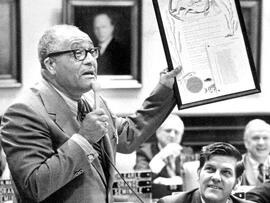
Joseph “Joe” Lang Kershaw, Sr. (June 27, 1911–November 7, 1999) was the first African American elected to the Florida Legislature since Reconstruction. Born in Live Oak, Florida, he attended Florida A&M University in the 1930s, where he was involved in early campus life, including the beginnings of the football program, and pledged Kappa Alpha Psi. He later worked as a teacher in Miami-Dade County and as a janitor in the Florida Legislature before entering politics. Elected to the Florida House of Representatives in 1968, Kershaw served for fourteen years and chaired the Elections Committee, contributing to the establishment of the Florida Human Rights Commission.
The Joseph Lang Kershaw, Sr. Collection documents Kershaw’s life, career, and contributions to Florida’s political and educational history. The collection contains materials related to his personal and academic background, as well as records reflecting his tenure in the Florida House of Representatives.
Included are documents that highlight his legislative work, professional activities, and community involvement. The collection also contains materials pertaining to his family, including references to his father, A. J. Kershaw, as well as correspondence and documents related to colleagues and contemporaries such as Gwendolyn Cherry and Althea Gibson. Collectively, these records provide insight into Kershaw’s role as a pioneering African American legislator and his broader impact on civil rights and public service in Florida.
Meek-Eaton Archival Collection AR_0012-Series 01
Part of James N. Eaton, Sr. Collection