
Showing 3 results

Archival description
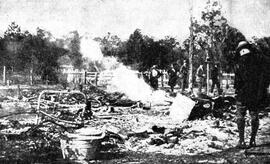
The Rosewood Massacre Papers
Meek-Eaton Archival Collection MS_0001 · Collection · 1900 - 1996

Location: AC.6.B.2.4.7-AC.6.B.3.4.4

The Rosewood Massacre was a racially motivated attack on the predominantly African American town of Rosewood, Florida, in January 1923. Sparked by false accusations and fueled by racial tensions under Jim Crow segregation, white mobs destroyed homes, churches, and businesses, forcing residents to flee and permanently abandon the town. For decades, the event remained largely suppressed in public memory until renewed attention in 1982 by journalist Gary Moore prompted survivors and descendants to seek justice. Their efforts led to a state investigation and compensation legislation, marking one of the first instances of reparations for racial violence in the United States.

Archival Description:
The Rosewood Massacre Papers Collection spans 35 boxes with materials dating from 1900 to 1996 and documents the historical, legal, and commemorative efforts surrounding the 1923 massacre. The collection includes narrative reports, multiple versions of documented histories, survivor affidavits, administrative files, correspondence, interview transcripts, handwritten notes, vital records such as birth certificates, census records including the 1920 U.S. Census, property records such as Levy County deed indexes, and materials related to claims verification.

Folders within the collection contain complete narrative reports and reproduced copies used for research, review, and preservation; affidavits from survivors including Bertha Fagin, Ivory T. Fuller, Vera G. Goins Hamilton, Thelma Hawkins, and Dorothy G. Hosey; correspondence from agencies such as the Florida State Department of Health and Rehabilitative Services and Offices of Vital Statistics; as well as administrative communications, genealogical documentation, and evidentiary records supporting compensation claims.

Collectively, these materials document both the historical reconstruction of the Rosewood Massacre and the legal and administrative processes undertaken to verify survivors, establish lineage, and secure restitution.
Meek-Eaton Archival Collection MS_0009 · Collection

Location: AC.8.B.1.1.1-AC.8.B.1.1.3

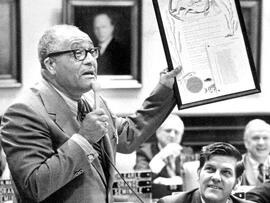
Joseph “Joe” Lang Kershaw, Sr. (June 27, 1911–November 7, 1999) was the first African American elected to the Florida Legislature since Reconstruction. Born in Live Oak, Florida, he attended Florida A&M University in the 1930s, where he was involved in early campus life, including the beginnings of the football program, and pledged Kappa Alpha Psi. He later worked as a teacher in Miami-Dade County and as a janitor in the Florida Legislature before entering politics. Elected to the Florida House of Representatives in 1968, Kershaw served for fourteen years and chaired the Elections Committee, contributing to the establishment of the Florida Human Rights Commission.

The Joseph Lang Kershaw, Sr. Collection documents Kershaw’s life, career, and contributions to Florida’s political and educational history. The collection contains materials related to his personal and academic background, as well as records reflecting his tenure in the Florida House of Representatives.

Included are documents that highlight his legislative work, professional activities, and community involvement. The collection also contains materials pertaining to his family, including references to his father, A. J. Kershaw, as well as correspondence and documents related to colleagues and contemporaries such as Gwendolyn Cherry and Althea Gibson. Collectively, these records provide insight into Kershaw’s role as a pioneering African American legislator and his broader impact on civil rights and public service in Florida.

Meek-Eaton Archival Collection MS_0023 · Collection · 1931 - 1939

Location: AC.8.A.2.4.3
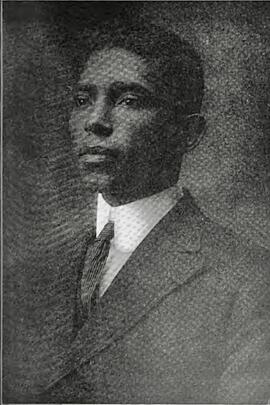
Bishop David Henry Sims was a prominent African American religious leader, educator, and administrator in the African Methodist Episcopal (A.M.E.) Church during the early twentieth century. Born in 1889 in Talladega, Alabama, he was the son of Reverend Felix Rice Sims, a well-educated minister who greatly influenced his early life and commitment to education and faith. Sims pursued higher education at several institutions, including Livingstone College, Oberlin College, and Yale University, where he completed advanced theological training.

Throughout his career, Sims held numerous leadership roles in both religious and academic settings. He served as a professor of education and later as vice president at Morris Brown College in Atlanta, Georgia. His work within the A.M.E. Church included pastoral leadership, administrative service, and participation in major church conferences. In 1932, he was elected Bishop in the A.M.E. Church, marking a significant achievement in his career.

Sims was also involved in broader social and political efforts, including service on commissions related to education and public affairs. His work extended internationally, particularly in South Africa, where he contributed to missionary and educational initiatives. His life and career reflect a deep commitment to religious leadership, education, and the advancement of African American communities during a period of significant social change.

The majority of the records in this collection are handwritten letters from Bishop Sims to his sister, Mrs. Miriam Sims-Tooke. These letters provide a detailed and intimate account of his daily life, thoughts, and activities, particularly during the period in which he was working in South Africa. Through this correspondence, the collection highlights Sims’ involvement in missionary work, his observations of social and cultural conditions abroad, and his ongoing connection to family in the United States.

In addition to correspondence, the collection includes greeting cards and photographs that further document Sims’ personal and professional networks. These materials complement the letters by providing visual and contextual evidence of his life and relationships during this period.

The collection was processed in 1985 and is arranged at the file level, reflecting a coherent grouping of personal papers centered on correspondence and related materials. Collectively, the Bishop David Henry Sims Collection offers a unique perspective on the experiences of an African American religious leader working in an international context, while also shedding light on familial bonds, missionary efforts, and transnational connections within the African diaspora during the early twentieth century.