
Location: AC.2.B.2.3.8
Billy Joe made the transition from a successful professional playing career to becoming one the most highly decorated black college football coaches in history. After two seasons as an assistant coach he got his first head coaching job at Cheyney State in 1972. He had a winning club that first season and stayed with the Wolves for six more years. Joe then honed his skills with two years as an assistant in the NFL before taking the head job at Central State (OH). There he turned the Marauders into a national black college power. In 13 years at CSU he had six seasons where he lost only one game. His second team made it to the NCAA Division II finals, the first of 11 consecutive playoff teams. In both 1990 and 1992 his teams won the NAIA national championship. In 1994, he moved to Florida A&M. Joe quickly built this program as well. His second team won a league title while his third went to the first of six straight playoff appearances with his 1999 team advancing to the national semi-finals. On the Black College level he won six national championships and is second only to Eddie Robinson on the all-time black coaching win list. Greatly respected by his peers, he served the American Football Coaches Association as both president and vice president.
https://footballfoundation.org/honors/hall-of-fame/billy-joe/2191
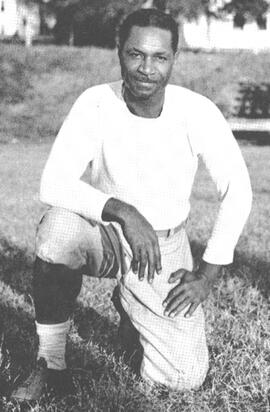
Location: AC.2.A.3.3.1 - AC.2.A.3.5.2
Born April 11, 1903 in Dayton, Tennessee, Alonzo S. "Jake" Gaither was head football coach of the FAMC Rattlers from 1945 to 1969. During his 25-year tenure, Gaither compiled a record of 203 wins, 36 losses, and 4 ties - for a winning percentage of .844, the highest for any college coach of his time, Black or white, with 200 victories.
Forty-two student athletes under Gaither's coaching went on to play in the National Football League including: "Bullet" Bob Hayes, a star wide receiver for the Dallas Cowboys who also earned two gold medals for track during the 1964 Summer Olympics in Tokyo; Willie Galimore, an acclaimed running back with the Chicago Bears; Ken Riley, a defensive back with the Cincinnati Bengals; and Robert Paremore, a halfback with the St. Louis Cardinals. Under his leadership, the Rattlers won 6 Negro Collegiate Football championships. Recognizing the dynamic impact of his coaching career, Gaither was inducted into the National Football Foundation Hall of Fame in 1975.
Gaither retired on August 31, 1973. He died February 18, 1994, at the age of 90. In Tallahassee, a FAMU gymnasium, community playground, public golf course, recreation center, street, and neighborhood are named in his honor. His private home, located at 212 Young Street, which he shared for more than 40 years with his late wife, Sadie (an English professor at Florida A&M University), has been preserved as a cultural center and museum to honor the Gaithers, the people of Tallahassee, the State of Florida, the nation, and the world. A historic marker was also installed in the home’s hilltop yard and the home listed on the National Register of Historic Places.
Jake GaitherLocation: AC.2.B.2.4.2
Clemon James Johnson Jr. (born September 12, 1956) is a former professional basketball player and coach from Monticello, Florida. He played college basketball at Florida A&M University from 1974 to 1978, where he earned degrees in economics and sports management.
Johnson went on to play 10 seasons in the NBA as a center and power forward, appearing in over 700 games with teams including the Portland Trail Blazers, Indiana Pacers, Philadelphia 76ers, and Seattle SuperSonics. He was a member of the 1983 NBA Championship team with the 76ers.
After his playing career, Johnson became a coach and educator, serving as head coach at the University of Alaska Fairbanks and later at his alma mater, Florida A&M University. His career reflects a lasting impact in both professional basketball and collegiate athletics. https://en.wikipedia.org/wiki/Clemon_Johnson
Location: AC.8.B.1.6.2
This file documents the life, military service, and posthumous recognition of Chester Lee Davis, Sr., one of the pioneering African American Marines trained at Montford Point during World War II. Spanning the years 1942 to 2017, this collection provides valuable insight into both Davis’s individual experiences and the broader historical significance of African American service members who served under segregated conditions in the United States Marine Corps.
Chester Lee Davis, Sr. (1923–1981) was born in Quincy, Florida, to Tommie and Iola Davis and was raised in a large farming family. Prior to the outbreak of World War II, his family relocated to Orlando, Florida. In 1943, at the age of eighteen, Davis enlisted in the United States Marine Corps, becoming part of the first generation of African American Marines admitted into service. Due to racial segregation, he trained at Montford Point Camp in North Carolina, a facility established specifically for Black Marines and located near Camp Lejeune, where white Marines trained. Despite facing systemic discrimination and harsh conditions, Davis served with distinction as a member of the 2nd and 3rd Marine Depot Companies. His responsibilities included transporting ammunition and supplies to troops on the frontlines, and he later participated in combat operations throughout the Pacific theater, including assignments in New Caledonia, Guadalcanal, the Solomon Islands, the Marshall Islands, Guam, and Okinawa. After completing his service, Davis returned home as a corporal and lived in Gadsden County, Florida, where he raised a family. He passed away in 1981 at the age of 58. In 2011, his service, along with that of fellow Montford Point Marines, was formally recognized when the United States Congress awarded them the Congressional Gold Medal, a distinction signed into law by President Barack Obama.
Donated to the Meek-Eaton Black Archives by Chester L. Davis, Jr. on June 13, 2017, the collection reflects a deliberate effort to preserve and share the legacy of Davis and other Montford Point Marines. The materials within the collection collectively document Davis’s military career, his contributions during World War II, and the national, state, and local recognition he received posthumously. The collection includes correspondence, legislative recognitions from the United States Congress, the State of Florida, and the City of Quincy, news articles, photographs depicting medals, military service, and commemorative events, as well as official service records and cassette tapes. These materials not only highlight Davis’s individual achievements but also situate his experiences within the broader narrative of African American military service and the struggle for equality within the armed forces.
At the time of processing in February 2017, the collection lacked an original order. As a result, the materials were organized by subject matter and date, then arranged alphabetically and housed in acid-free folders within a single archival storage box. Where applicable, items within individual files have been arranged chronologically to preserve contextual relationships. The collection was processed and cataloged by Dr. Murell Dawson, Senior Archivist, with assistance from undergraduate intern Shaarnè Morris, and is currently stored in the archival storage area on the third floor. As a cohesive body of records, this collection provides an important resource for understanding the experiences of Montford Point Marines and the enduring legacy of their service, sacrifice, and recognition within American military and social history.
Location: AC.3.B.1.5.7
Charles Winter Wood (1869–1953) was an accomplished educator, actor, and pioneer in African American theatre and higher education. Born in Nashville, Tennessee, he became one of the first Black graduates of Beloit College and later earned advanced degrees from Chicago Theological Seminary and Columbia University.
Wood spent over 30 years teaching at Tuskegee Institute, where he led the English and drama departments and also served as a football coach. He later joined Florida A&M University as a teacher of dramatic arts, helping to develop its theatre program.
In addition to his academic work, Wood was a successful stage actor, notably performing in the Broadway production The Green Pastures. His career reflects a lasting legacy in education, theatre, and the advancement of Black cultural expression.
Location: AC.8.B.2.4.3
Mr. Charles Hamilton was an African-American landowner, farmer, and businessman who lived
in Marion County, Florida, during the late 1800s and turn of the twentieth century. Marion
The county is located in Central Florida. According to information from the 1900 US Census, the
Hamilton Family patriarch, listed as Charly Hamilton, was born during slavery in 1853 and
possibly migrated to Florida from South Carolina after the Civil War. Charly and his wife
Georgia had three sons, Richard, Charlie, and Jonas, and two daughters, Estelle and Texella.
Hamilton and his descendants also owned property and conducted business in neighboring Levy
County.
Location: AC.7A.3.1.2- AC.7A.3.2.2
The Central Life Insurance Company of Florida Collection documents the operations, administrative activities, and historical record of the Central Life Insurance Company of Florida through corporate records, certificates, photographs, and ephemera spanning from 1922 to 1987. The collection includes blank certificates, certificates issued to policyholders, stock certificates, occupational licenses, newspaper clippings, and photographic materials documenting company personnel, activities, and community engagement. Together, these materials provide insight into the business practices, visual history, and public presence of the company during the twentieth century.
This collection consists of administrative records, financial documentation, and visual materials related to the Central Life Insurance Company of Florida. The records include blank certificates used by the company, certificates issued to policyholders, occupational licenses, stock certificates, and a stockholders list. The collection also contains newspaper clippings documenting company activities and public recognition. Photographic materials form a significant portion of the collection and include black-and-white prints in various sizes, snapshot photographs, oblong photographs, oversized prints, and photographic negatives depicting company employees, events, and community involvement.
These records provide documentation of the company’s corporate operations as well as its role within the broader community. The materials date from 1922 through 1987 and reflect both the administrative and public-facing aspects of the organization.
The materials are arranged by record type and subject. Administrative documents and certificates appear first, followed by miscellaneous materials and printed ephemera, with photographic materials organized by size and format. Stock certificates and a stockholders list conclude the collection.
The records were processed following a preliminary survey of the materials. Documents were sorted by record type and subject. Rusting hardware was removed, and the materials were rehoused in acid-free folders and archival boxes. The files were arranged alphabetically and by format where appropriate.
The Central Life Insurance Company of Florida records were transferred to the Black Archives from the Florida Department of Insurance.
Location: AC.3.A.1.4.2 - AC.3.A.1.4.6
Carrie P. Meek (1926–2021) was a pioneering educator, politician, and civil rights advocate who made a lasting impact in Florida and across the nation. Born in Tallahassee, Florida, she graduated from Florida A&M University and later earned a master’s degree from the University of Michigan.
Meek began her career as a teacher and later served as an administrator at Miami-Dade Community College, where she worked to expand access to higher education. She entered politics in the 1970s, becoming one of the first African American women elected to the Florida Legislature. In 1992, she made history as the first Black person elected to the U.S. House of Representatives from Florida since Reconstruction, representing Miami-Dade County.
Throughout her career, Meek was a strong advocate for education, economic opportunity, and social justice. Known for her dedication to underserved communities, she helped secure funding for infrastructure, job programs, and education initiatives. Her legacy endures as a trailblazer who opened doors for future generations in public service and politics.
Location: AC.2.B.1.4.3
Location: AC.7.A.1.2.2 - AC.7.A.1.5.3
The Black Schools in Florida Collection documents the history, administration, and cultural life of African American education in Florida during the era of segregation and beyond. Comprising twelve boxes of materials, this collection provides rich insight into the development of Black primary and secondary schools, as well as the educators, administrators, and communities that sustained them. The records collectively highlight the structure of segregated schooling, the professional networks of Black educators, and the efforts toward institutional improvement and accreditation.
The collection consists of a wide range of materials, including correspondences, school records, conference records, and publications that reflect the daily operations and broader educational initiatives of Black schools throughout the state. Printed materials such as programs, event programs, yearbooks, newspapers, and school publications illustrate student life, extracurricular activities, and community engagement. Additional items, including certificates of membership, certificates of accreditation, high school diploma covers, plaques, and school emblems, provide evidence of institutional identity, achievement, and recognition.
Educational development and administrative practices are further represented through instructional materials and reports, including a self-study of Nims Middle School, an instructional book for Duval County middle schools, a junior high school handbook, and documentation related to teacher workshops and professional training. The collection also includes records such as a statewide list of Negro principals and materials pertaining to educators in Gadsden County, offering valuable context on leadership and staffing within Black educational institutions. Notably, one empty box labeled “Foreign Affairs” is present, suggesting either removed or relocated materials.
Photographs within the collection visually document school buildings, faculty, students, and events, complementing the textual records and enhancing the historical narrative. Together, these materials provide a comprehensive view of the educational experiences of African American students and educators in Florida, emphasizing both the challenges of segregation and the resilience and accomplishments of Black school communities.