MS_0081
Location: AC.3.A.1.5.6

Location: AC.3.A.1.5.6
Location: AC.3.A.1.6.1 - AC.3.A.2.1.6; AC.3.B.3.3.3
Location: AC.3.A.1.7.1
Location: AC.3.A.3.1.4 - AC.3.A.3.2.2
Location: AC.3.A.3.6.1 - AC.3.A.3.6.2
Location: AC.3.B.1.2.2
Location: AC.3.B.1.7.1
Location: AC.1.B.2.1.1 - AC.1.B.2.1.6
Asa Philip Randolph (1889–1979) was a pioneering labor leader and civil rights activist who played a major role in advancing equality for African Americans. Born in Florida, he organized the Brotherhood of Sleeping Car Porters in 1925, the first successful Black-led labor union, and became a leading voice for workers’ rights and racial justice.
Randolph helped pressure the federal government to end discrimination in defense industries during World War II and was a key organizer of the 1963 March on Washington, where Dr. Martin Luther King Jr. delivered his famous “I Have a Dream” speech. His lifelong commitment to nonviolent protest, labor rights, and civil rights made him one of the most influential leaders of the 20th century.
Location: AC.6.B.2.4.7-AC.6.B.3.4.4
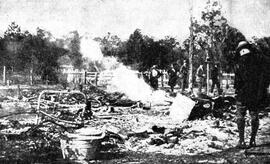
The Rosewood Massacre was a racially motivated attack on the predominantly African American town of Rosewood, Florida, in January 1923. Sparked by false accusations and fueled by racial tensions under Jim Crow segregation, white mobs destroyed homes, churches, and businesses, forcing residents to flee and permanently abandon the town. For decades, the event remained largely suppressed in public memory until renewed attention in 1982 by journalist Gary Moore prompted survivors and descendants to seek justice. Their efforts led to a state investigation and compensation legislation, marking one of the first instances of reparations for racial violence in the United States.
Archival Description:
The Rosewood Massacre Papers Collection spans 35 boxes with materials dating from 1900 to 1996 and documents the historical, legal, and commemorative efforts surrounding the 1923 massacre. The collection includes narrative reports, multiple versions of documented histories, survivor affidavits, administrative files, correspondence, interview transcripts, handwritten notes, vital records such as birth certificates, census records including the 1920 U.S. Census, property records such as Levy County deed indexes, and materials related to claims verification.
Folders within the collection contain complete narrative reports and reproduced copies used for research, review, and preservation; affidavits from survivors including Bertha Fagin, Ivory T. Fuller, Vera G. Goins Hamilton, Thelma Hawkins, and Dorothy G. Hosey; correspondence from agencies such as the Florida State Department of Health and Rehabilitative Services and Offices of Vital Statistics; as well as administrative communications, genealogical documentation, and evidentiary records supporting compensation claims.
Collectively, these materials document both the historical reconstruction of the Rosewood Massacre and the legal and administrative processes undertaken to verify survivors, establish lineage, and secure restitution.
Location: R.4.A.4.1.1
The FAMU Hospital first started in 1911 as a sanitorium supervised by Nurse Virginia Hilyer. For many years this clinic served the student population and when an annex was added to the hospital in 1922 services were opened to the larger Tallahassee community, with services provided by doctors from all over the city to all ethnicities. African American physicians in Tallahassee also served at the hospital including, Drs. William G. Gunn, Alpha Omega Campbell, and L.H.B. Foote.
It was under L. H. B. Foote's directorship that the first annual Medical Clinic was hosted on campus in 1926. The Medical Clinic was created to host informational presentations and networking between medical professionals and education groups and later fused with Florida A&M Clinical Association. The clinical association's focus on sharing knowledge, resources, and training opportunities to medical professionals throughout Florida, Georgia, and Alabama added to the overall goal of getting modern medical care to Black patients.
The 1930s saw several initiatives blooming at the campus hospital; continued expansions to the hospital, the campaign to add a nursing training facility, and partnerships with the Florida State Board of Health to host midwife training workshops all created an air of growth, advancement, and modernity. It took twenty ear and two university presidents (J.R.E. Lee and George W. Gore) to establish the full hospital and nurse training unit on the basis of the already existing hospital that would serve African Americans from Tallahassee and surrounding counties.
It took federal grants, support from the Tallahassee City Commission, and a capital campaign that included donations from various civic leagues and from a stymied effort to build a Black hospital in Jacksonville to gather the $2,000,000 needed for the facility but finally it was done. The grand opening was opening liberally celebrated.
Through the 1960s, the FAMU Hospital continued to serve the community but advancements in civil rights for African Americans had a surprising adverse affect--in the effort to integrate both Tallahassee Memorial Hospital and FAMU Hospital both institutions were issued orders to integrate, which should not have been a problem for FAMU Hospital since it had always employed both Black and White doctors and been open to all patients. However, withdrawal of state and federal financial support for the hospital and accusations of mismanagement of funds began to compromise it's efficacy and by the end of the decade plans were already in motion for its closure. The hospital officially closed in 1971 and in 1981 the building housing the hospital was remodeled and rededicated as the Foote-Hilyer Administration Building, containing the University's administrative offices and Student Health Services.
This collection comprises primarily correspondence, reports, and publications of the FAMU Hospital Fund Committee--tasked with raising and organizing funds for the hospital expansion of 1951, and administrative records of the Hospital Advisory Board--tasked with governing the FAMU Hospital during its existence from 1951 to 1971. Much of the correspondence is to or from Dr. George W. Gore, FAMU's eighth University President. Other figures of note are then-Senator Leroy Collins, who served as the Chairman of the Advisory Board; Dr. LH.B. Foote who also served on the Hospital Advisory Board. Other organizations and offices whose activities are recorded in this collection are FAMU Clinical Association; the Board of Regents; the Board of Control; Leon County; and the City of Tallahassee as it relates to the establishment, management, and dissolution of the FAMU Hospital.
Some of the significant topics represented in these files are the complexities of desegregation and integration; Black hospital management; public health; nurse training and education; professional development; fundraising.
Items were arranged in series by type of communication object, sorted into folders chronologically, and each series arranged alphabetically. Attachments are listed alphanumerically starting with the item number of the document they were originally attached to. All hardware was removed and documents sleeved. Some documents will require flattening, cleaning, and other conservation efforts.