Showing 99 results

Archival description
12 results with digital objects Show results with digital objects
Willie Galimore Collection
Meek-Eaton Archival Collection MS_0046

Location: AC.2.A.3.5.3
Willie Galimore (1935–1964) was a legendary football player and standout athlete at Florida A&M University. Born in St. Augustine, Florida, he became one of the greatest players in FAMU history, earning All-American honors and leading the Rattlers to multiple conference championships under coach Jake Gaither.

Nicknamed “the Wisp” for his speed and agility, Galimore went on to play professionally for the Chicago Bears, where he was a Pro Bowl selection and helped win the 1963 NFL Championship.

Galimore’s life was tragically cut short at age 29 in an automobile accident, but his legacy endures as one of the most influential athletes in HBCU football history and a member of the College Football Hall of Fame.

https://footballfoundation.org/honors/hall-of-fame/willie-galimore/1830

Tonnette Graham Collection
Meek-Eaton Archival Collection MS_0047

Location: AC.2.A.3.6.3
Tonnette Graham is a Florida A&M University alumna, public policy professional, and former student leader known for her impact in both higher education and government. While at Florida A&M University, she served as Student Body President and held multiple leadership roles, becoming a prominent voice for students at the university and across the state.

After graduating with a degree in healthcare management and later earning a master’s in public administration, Graham built a career in policy and advocacy. She serves as Associate Director of Public Policy for the Florida Association of Counties, where she works on legislative issues related to healthcare, public safety, and economic development.

Graham is also recognized for her continued commitment to service and leadership, remaining actively involved in community organizations and initiatives in the Tallahassee area while contributing to public policy at the state level.

https://www.tallahassee.com/story/news/2015/06/09/famus-tonnette-graham-finds-success-juggling-leadership-roles/28729949/?gnt-cfr=1&gca-cat=p&gca-uir=true&gca-epti=z118051e007700v118051d--89--b--89--&gca-ft=157&gca-ds=sophi

Thelma Gorham Collection
Meek-Eaton Archival Collection MS_0033

Location: AC.2.A.3.6.4 - AC.2.A.3.6.5; AC.2.B.1.1.1 - AC.2.B.1.3.2

Thelma Thurston Gorham (1913–1992) was a pioneering journalist, educator, and academic leader who made a lasting impact on journalism education at Florida A&M University. Born in Kansas City, Missouri, she earned her bachelor’s and master’s degrees from the University of Minnesota and later completed her Ph.D. at Florida State University.

Gorham began her career as a journalist, writing and editing for several Black newspapers, including the Kansas City Call, Apache Sentinel, and The Black Dispatch. During the 1930s, she broke barriers as one of the first Black female reporters in the United States.

She went on to a distinguished career in higher education, teaching at multiple historically Black colleges and universities before joining Florida A&M University. There, she founded the School of Journalism and helped shape generations of students, contributing significantly to the development of journalism programs at HBCUs.

Gorham spent many years at FAMU before retiring and remained a respected figure in both journalism and education until her passing in Tallahassee, Florida, in 1992. Her legacy continues through the Thelma Thurston Gorham Distinguished Alumni Award, which recognizes excellence in journalism and communication.

https://en.wikipedia.org/wiki/Thelma_Thurston_Gorham

The Rosewood Massacre Papers
Meek-Eaton Archival Collection MS_0001 · Collection · 1900 - 1996

Location: AC.6.B.2.4.7-AC.6.B.3.4.4

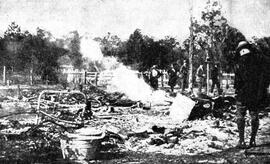
The Rosewood Massacre was a racially motivated attack on the predominantly African American town of Rosewood, Florida, in January 1923. Sparked by false accusations and fueled by racial tensions under Jim Crow segregation, white mobs destroyed homes, churches, and businesses, forcing residents to flee and permanently abandon the town. For decades, the event remained largely suppressed in public memory until renewed attention in 1982 by journalist Gary Moore prompted survivors and descendants to seek justice. Their efforts led to a state investigation and compensation legislation, marking one of the first instances of reparations for racial violence in the United States.

Archival Description:
The Rosewood Massacre Papers Collection spans 35 boxes with materials dating from 1900 to 1996 and documents the historical, legal, and commemorative efforts surrounding the 1923 massacre. The collection includes narrative reports, multiple versions of documented histories, survivor affidavits, administrative files, correspondence, interview transcripts, handwritten notes, vital records such as birth certificates, census records including the 1920 U.S. Census, property records such as Levy County deed indexes, and materials related to claims verification.

Folders within the collection contain complete narrative reports and reproduced copies used for research, review, and preservation; affidavits from survivors including Bertha Fagin, Ivory T. Fuller, Vera G. Goins Hamilton, Thelma Hawkins, and Dorothy G. Hosey; correspondence from agencies such as the Florida State Department of Health and Rehabilitative Services and Offices of Vital Statistics; as well as administrative communications, genealogical documentation, and evidentiary records supporting compensation claims.

Collectively, these materials document both the historical reconstruction of the Rosewood Massacre and the legal and administrative processes undertaken to verify survivors, establish lineage, and secure restitution.

Southern Workman Collection
Meek-Eaton Archival Collection MS_0118 · 1910 - 1939

Location: AC.6.B.4.3.4 - AC.6.B.4.3.8

The Southern Workman Collection consists of five boxes of materials dating from 1910 to 1939, documenting a significant period in the publication history of The Southern Workman. Published monthly by the Hampton Institute Press at Hampton Institute (now Hampton University), the magazine originated in 1872 as Southern Workman and Hampton School Record and served as an important platform for education, culture, and social commentary.

The collection includes issues of the magazine featuring articles, lectures, essays, and book reviews that reflect the intellectual and cultural life of the institution. Content highlights the activities of Hampton Institute, including information about its faculty, students, and graduates, while also addressing broader social issues of the time.

With a primary focus on African American and Native American history, the materials provide valuable insight into educational practices, cultural expression, and social conditions in the early twentieth century. Collectively, the collection illustrates the role of The Southern Workman as a key publication in advancing knowledge and documenting the experiences and contributions of marginalized communities.

Meek-Eaton Archival Collection MS_0120 · 1954 - 1965

Location: AC.6.B.4.2.7 - AC.6.B.4.3.3

The Southern School News Collection consists of issues of Southern School News, a publication produced by the Southern Education Reporting Service between 1954 and 1965. Established in response to the landmark 1954 Supreme Court decision in Brown v. Board of Education, the Southern Education Reporting Service sought to provide nonpartisan, factual reporting on the evolving landscape of public education in the American South during the era of school desegregation.

The publication was designed to inform school administrators, public officials, educators, and interested citizens about significant developments in education following the Court’s ruling. Reports featured in Southern School News were compiled by southern newspaper editors and educators, offering regionally grounded perspectives on policy changes, legal challenges, community responses, and the progress of desegregation efforts across southern states.

The collection includes serial issues of Southern School News that document key events, debates, and implementation strategies related to desegregation. These materials provide detailed accounts of state and local actions, including legislative measures, court cases, school board decisions, and public reactions. As a contemporary source, the publication captures the complexities and tensions surrounding the transition from segregated to integrated school systems in the South.

Collectively, the Southern School News Collection serves as an important resource for understanding the educational, political, and social transformations that followed the Brown decision. It offers researchers valuable insight into how information about desegregation was disseminated, interpreted, and contested, while also highlighting the role of media and educators in documenting one of the most significant periods in American educational history.

Meek-Eaton Archival Collection MS_0071 · File

Location: AC.2.B.2.4.4 - AC.2.B.3.1.3

Arthenia L. Joyner born 1943 in Lakeland, Florida, and raised in Tampa. She emerged as a leader during the Civil Rights Movement, participating in protests as both a high school and college student at Florida A&M University. Joyner attended the original FAMU College of Law, graduating in 1968, and went on to break significant barriers as the first Black woman to practice law in Hillsborough County and the first African American to practice law in Polk County. She later served as a legislative aide to State Representative Joe Lang Kershaw, the first Black legislator in Florida since Reconstruction, and was elected to three terms in the Florida House of Representatives representing the 59th District.

The Senator Arthenia L. Joyner Collection consists of eight boxes of materials documenting her career in law, public service, and civil rights advocacy. The collection includes correspondence, meeting records, travel documents, and speeches that reflect her work as an attorney, legislative aide, and elected official.

These materials provide insight into Joyner’s role in shaping public policy, her legislative activities, and her engagement with constituents and colleagues. The collection also highlights her involvement in civil rights initiatives and her contributions to expanding opportunities for African Americans in the legal and political arenas. Collectively, the records document her impact on Florida’s political landscape and her legacy as a pioneering African American woman in law and government.

Senator Al Lawson Collection
Meek-Eaton Archival Collection MS_0075

Location: AC.2.B.3.3.4
Alfred James “Al” Lawson Jr. (born 1948) is an American politician, former athlete, and longtime public servant from Florida. Born in Midway, Florida, he graduated from Florida A&M University, where he was a standout basketball player, and later earned a master’s degree from Florida State University.

Lawson began his career as a professional basketball player and coach before transitioning into politics. He served for nearly three decades in the Florida Legislature, including time in both the House of Representatives and the Senate, where he rose to leadership positions.

In 2017, Lawson was elected to the U.S. House of Representatives, representing Florida’s 5th Congressional District until 2023. Throughout his career, he has been known for his advocacy on issues such as agriculture, economic development, and support for underserved communities.

Rudy L. Hubbard Collection
Meek-Eaton Archival Collection MS_0064

Location: AC.2.B.2.3.1
Rudy Hubbard was the head coach of FAMU’s football program from 1974 to 1985. He led the Rattlers to the first-ever NCAA Division I-AA title in 1978.