
Location: AC.1.B.2.1.1 - AC.1.B.2.1.6
Asa Philip Randolph (1889–1979) was a pioneering labor leader and civil rights activist who played a major role in advancing equality for African Americans. Born in Florida, he organized the Brotherhood of Sleeping Car Porters in 1925, the first successful Black-led labor union, and became a leading voice for workers’ rights and racial justice.
Randolph helped pressure the federal government to end discrimination in defense industries during World War II and was a key organizer of the 1963 March on Washington, where Dr. Martin Luther King Jr. delivered his famous “I Have a Dream” speech. His lifelong commitment to nonviolent protest, labor rights, and civil rights made him one of the most influential leaders of the 20th century.
African American History
13 Descripción archivística resultados para African American History
13 resultados directamente relacionados
Excluir términos relacionados
MS_0114
Meek-Eaton Archival Collection MS_0001
·
Colección
·
1900 - 1996
Location: AC.6.B.2.4.7-AC.6.B.3.4.4
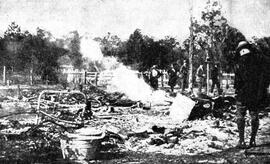
The Rosewood Massacre was a racially motivated attack on the predominantly African American town of Rosewood, Florida, in January 1923. Sparked by false accusations and fueled by racial tensions under Jim Crow segregation, white mobs destroyed homes, churches, and businesses, forcing residents to flee and permanently abandon the town. For decades, the event remained largely suppressed in public memory until renewed attention in 1982 by journalist Gary Moore prompted survivors and descendants to seek justice. Their efforts led to a state investigation and compensation legislation, marking one of the first instances of reparations for racial violence in the United States.
Archival Description:
The Rosewood Massacre Papers Collection spans 35 boxes with materials dating from 1900 to 1996 and documents the historical, legal, and commemorative efforts surrounding the 1923 massacre. The collection includes narrative reports, multiple versions of documented histories, survivor affidavits, administrative files, correspondence, interview transcripts, handwritten notes, vital records such as birth certificates, census records including the 1920 U.S. Census, property records such as Levy County deed indexes, and materials related to claims verification.
Folders within the collection contain complete narrative reports and reproduced copies used for research, review, and preservation; affidavits from survivors including Bertha Fagin, Ivory T. Fuller, Vera G. Goins Hamilton, Thelma Hawkins, and Dorothy G. Hosey; correspondence from agencies such as the Florida State Department of Health and Rehabilitative Services and Offices of Vital Statistics; as well as administrative communications, genealogical documentation, and evidentiary records supporting compensation claims.
Collectively, these materials document both the historical reconstruction of the Rosewood Massacre and the legal and administrative processes undertaken to verify survivors, establish lineage, and secure restitution.
Meek-Eaton Archival Collection MS_0016-Box 01
·
1942 - 2017
Parte de Chester L. Davis, Sr. Collection
This box provides a focused view of Davis’s contributions within the broader historical context of African American military service during segregation, as well as the continued efforts to honor his legacy at the local, state, and national levels.
The records within this box consist of a variety of formats, including correspondence, legislative recognitions, photographs, news articles, cassette tapes, and official service-related documentation. Early materials dating from the 1940s reflect Davis’s World War II service and include photographic and documentary evidence associated with the Congressional Gold Medal and other recognitions tied to the Montford Point Marines. These records highlight the significance of Davis’s role within one of the first groups of African Americans to serve in the United States Marine Corps.
Correspondence files within the box provide insight into communication between Davis or his representatives and notable individuals and institutions, including the Marine Corps Archives and various public officials. Legislative recognitions from entities such as the United States Congress, the State of Florida, and the City of Quincy further emphasize the long-overdue acknowledgment of Davis’s service and sacrifice. Photographic materials document both his military-related achievements and commemorative events, including images of medals, awards, and presentations involving public figures and family members.
Additional materials, including news articles and cassette tapes, contribute to a broader understanding of how Davis’s story has been preserved, interpreted, and shared over time. The inclusion of official service records and undated photographs provides further documentation of his military experience and personal life. Collectively, these materials illustrate the enduring impact of Davis’s service, as well as the evolving recognition of Montford Point Marines in American history.
The records in Box 1 are arranged by subject and record type, with files organized alphabetically and materials within files arranged chronologically where applicable. This organization facilitates access while preserving the contextual relationships between documents. As a cohesive unit, Box 1 serves as a significant resource for researchers examining African American military history, World War II service, and the legacy of the Montford Point Marines.