
Location: AC.6.B.2.4.7-AC.6.B.3.4.4
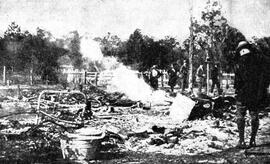
The Rosewood Massacre was a racially motivated attack on the predominantly African American town of Rosewood, Florida, in January 1923. Sparked by false accusations and fueled by racial tensions under Jim Crow segregation, white mobs destroyed homes, churches, and businesses, forcing residents to flee and permanently abandon the town. For decades, the event remained largely suppressed in public memory until renewed attention in 1982 by journalist Gary Moore prompted survivors and descendants to seek justice. Their efforts led to a state investigation and compensation legislation, marking one of the first instances of reparations for racial violence in the United States.
Archival Description:
The Rosewood Massacre Papers Collection spans 35 boxes with materials dating from 1900 to 1996 and documents the historical, legal, and commemorative efforts surrounding the 1923 massacre. The collection includes narrative reports, multiple versions of documented histories, survivor affidavits, administrative files, correspondence, interview transcripts, handwritten notes, vital records such as birth certificates, census records including the 1920 U.S. Census, property records such as Levy County deed indexes, and materials related to claims verification.
Folders within the collection contain complete narrative reports and reproduced copies used for research, review, and preservation; affidavits from survivors including Bertha Fagin, Ivory T. Fuller, Vera G. Goins Hamilton, Thelma Hawkins, and Dorothy G. Hosey; correspondence from agencies such as the Florida State Department of Health and Rehabilitative Services and Offices of Vital Statistics; as well as administrative communications, genealogical documentation, and evidentiary records supporting compensation claims.
Collectively, these materials document both the historical reconstruction of the Rosewood Massacre and the legal and administrative processes undertaken to verify survivors, establish lineage, and secure restitution.