
Showing 4 results

Archival description
2 results with digital objects Show results with digital objects
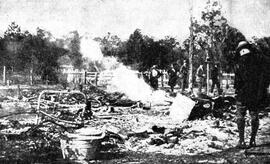
The Rosewood Massacre Papers
Meek-Eaton Archival Collection MS_0001 · Collection · 1900 - 1996

Location: AC.6.B.2.4.7-AC.6.B.3.4.4

The Rosewood Massacre was a racially motivated attack on the predominantly African American town of Rosewood, Florida, in January 1923. Sparked by false accusations and fueled by racial tensions under Jim Crow segregation, white mobs destroyed homes, churches, and businesses, forcing residents to flee and permanently abandon the town. For decades, the event remained largely suppressed in public memory until renewed attention in 1982 by journalist Gary Moore prompted survivors and descendants to seek justice. Their efforts led to a state investigation and compensation legislation, marking one of the first instances of reparations for racial violence in the United States.

Archival Description:
The Rosewood Massacre Papers Collection spans 35 boxes with materials dating from 1900 to 1996 and documents the historical, legal, and commemorative efforts surrounding the 1923 massacre. The collection includes narrative reports, multiple versions of documented histories, survivor affidavits, administrative files, correspondence, interview transcripts, handwritten notes, vital records such as birth certificates, census records including the 1920 U.S. Census, property records such as Levy County deed indexes, and materials related to claims verification.

Folders within the collection contain complete narrative reports and reproduced copies used for research, review, and preservation; affidavits from survivors including Bertha Fagin, Ivory T. Fuller, Vera G. Goins Hamilton, Thelma Hawkins, and Dorothy G. Hosey; correspondence from agencies such as the Florida State Department of Health and Rehabilitative Services and Offices of Vital Statistics; as well as administrative communications, genealogical documentation, and evidentiary records supporting compensation claims.

Collectively, these materials document both the historical reconstruction of the Rosewood Massacre and the legal and administrative processes undertaken to verify survivors, establish lineage, and secure restitution.
Meek-Eaton Archival Collection MS_0009 · Collection

Location: AC.8.B.1.1.1-AC.8.B.1.1.3

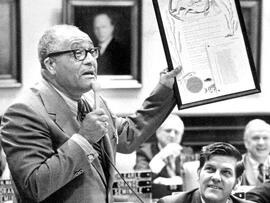
Joseph “Joe” Lang Kershaw, Sr. (June 27, 1911–November 7, 1999) was the first African American elected to the Florida Legislature since Reconstruction. Born in Live Oak, Florida, he attended Florida A&M University in the 1930s, where he was involved in early campus life, including the beginnings of the football program, and pledged Kappa Alpha Psi. He later worked as a teacher in Miami-Dade County and as a janitor in the Florida Legislature before entering politics. Elected to the Florida House of Representatives in 1968, Kershaw served for fourteen years and chaired the Elections Committee, contributing to the establishment of the Florida Human Rights Commission.

The Joseph Lang Kershaw, Sr. Collection documents Kershaw’s life, career, and contributions to Florida’s political and educational history. The collection contains materials related to his personal and academic background, as well as records reflecting his tenure in the Florida House of Representatives.

Included are documents that highlight his legislative work, professional activities, and community involvement. The collection also contains materials pertaining to his family, including references to his father, A. J. Kershaw, as well as correspondence and documents related to colleagues and contemporaries such as Gwendolyn Cherry and Althea Gibson. Collectively, these records provide insight into Kershaw’s role as a pioneering African American legislator and his broader impact on civil rights and public service in Florida.

Harper's Magazine Collection
Meek-Eaton Archival Collection MS_0113 · Collection · 1876 - 1965

Location: AC.6.B.1.2.1

The Harper’s Magazine Collection consists of one box of materials spanning the years 1876 to 1965, documenting a significant portion of one of America’s oldest and most influential general-interest monthly publications. Founded in 1850 by the New York publishing firm Harper & Brothers, Harper’s Magazine quickly gained national prominence, with its early issues achieving widespread circulation and establishing the publication as a leading forum for intellectual and cultural discourse.

This collection reflects the magazine’s longstanding commitment to exploring the issues that shape American society through long-form journalism, essays, fiction, and critical commentary. Emphasizing fine writing and original thought, Harper’s Magazine has historically provided readers with insightful perspectives on politics, social conditions, the environment, and cultural life. The materials within this collection illustrate the breadth of topics addressed in the magazine and its role in fostering national conversation across generations.

The collection includes a selection of issues and related materials that highlight contributions from both emerging writers and prominent literary figures. Known for publishing influential voices in American letters, the magazine has featured authors such as Annie Dillard, Barbara Ehrenreich, Jonathan Franzen, Mary Gaitskill, David Foster Wallace, and Tom Wolfe.

Collectively, this collection offers valuable insight into the evolution of American journalism, literary expression, and public discourse from the late nineteenth century through the mid-twentieth century.

Meek-Eaton Archival Collection MS_0016 · Collection · 1942 - 2017

Location: AC.8.B.1.6.2

This file documents the life, military service, and posthumous recognition of Chester Lee Davis, Sr., one of the pioneering African American Marines trained at Montford Point during World War II. Spanning the years 1942 to 2017, this collection provides valuable insight into both Davis’s individual experiences and the broader historical significance of African American service members who served under segregated conditions in the United States Marine Corps.

Chester Lee Davis, Sr. (1923–1981) was born in Quincy, Florida, to Tommie and Iola Davis and was raised in a large farming family. Prior to the outbreak of World War II, his family relocated to Orlando, Florida. In 1943, at the age of eighteen, Davis enlisted in the United States Marine Corps, becoming part of the first generation of African American Marines admitted into service. Due to racial segregation, he trained at Montford Point Camp in North Carolina, a facility established specifically for Black Marines and located near Camp Lejeune, where white Marines trained. Despite facing systemic discrimination and harsh conditions, Davis served with distinction as a member of the 2nd and 3rd Marine Depot Companies. His responsibilities included transporting ammunition and supplies to troops on the frontlines, and he later participated in combat operations throughout the Pacific theater, including assignments in New Caledonia, Guadalcanal, the Solomon Islands, the Marshall Islands, Guam, and Okinawa. After completing his service, Davis returned home as a corporal and lived in Gadsden County, Florida, where he raised a family. He passed away in 1981 at the age of 58. In 2011, his service, along with that of fellow Montford Point Marines, was formally recognized when the United States Congress awarded them the Congressional Gold Medal, a distinction signed into law by President Barack Obama.

Donated to the Meek-Eaton Black Archives by Chester L. Davis, Jr. on June 13, 2017, the collection reflects a deliberate effort to preserve and share the legacy of Davis and other Montford Point Marines. The materials within the collection collectively document Davis’s military career, his contributions during World War II, and the national, state, and local recognition he received posthumously. The collection includes correspondence, legislative recognitions from the United States Congress, the State of Florida, and the City of Quincy, news articles, photographs depicting medals, military service, and commemorative events, as well as official service records and cassette tapes. These materials not only highlight Davis’s individual achievements but also situate his experiences within the broader narrative of African American military service and the struggle for equality within the armed forces.

At the time of processing in February 2017, the collection lacked an original order. As a result, the materials were organized by subject matter and date, then arranged alphabetically and housed in acid-free folders within a single archival storage box. Where applicable, items within individual files have been arranged chronologically to preserve contextual relationships. The collection was processed and cataloged by Dr. Murell Dawson, Senior Archivist, with assistance from undergraduate intern Shaarnè Morris, and is currently stored in the archival storage area on the third floor. As a cohesive body of records, this collection provides an important resource for understanding the experiences of Montford Point Marines and the enduring legacy of their service, sacrifice, and recognition within American military and social history.