Civil Rights

Área de elementos

Taxonomia

Código

Nota(s) de âmbito

    Nota(s) da fonte

      Mostrar nota(s)

        Termos hierárquicos

        Civil Rights

          Termos equivalentes

          Civil Rights

            Termos associados

            Civil Rights

              36 Descrição arquivística resultados para Civil Rights

              36 resultados diretamente relacionados Excluir termos específicos
              Arthur L. Kidd Collection
              Meek-Eaton Archival Collection MS_0013 · Coleção · 1934 - 1967

              Location: AC.2.B.3.2.2- AC.2.B.3.2.5

              This collection consists of personal papers from Florida A&M University’s Arthur L. Kidd. Kidd, a native of Pennsylvania, earned a B.A. degree in 1924 from the University of Michigan, and in 1929, a Masters of Arts degree from Columbia University. Kidd also did additional studying at the University of Iowa, Columbia University, and New York University. He began his teaching career at Tuskegee Institute in 1924 before accepting a position at Florida A&M College (FAMCEE) in 1925 as Principal of the High School. Kidd worked at FAMCEE until 1944. During his nineteen years of service to the college, Kidd worked in numerous positions, including: Head of the Department of History, Acting Director of the Extension Division, Acting Dean for the College of Arts and Sciences and College Registrar. In October 1944, Kidd left his position at FAMCEE to work with the United Nations Relief and Rehabilitation Administration, where he worked in various capacities in Washington, D.C., and abroad in locations including France, Germany, and Holland. He returned to the United States in 1950 and worked for a year at Maryland State College before accepting a second appointment at FAMCEE in 1951 as Director of the Division of Social Studies. Upon the college reaching university status in 1954, in the academic re-organization, Kidd consequently became the Associate Dean of the College of Arts and Sciences. Until 1969, he served FAMU in various capacities, including director of institutional studies and director of university administrative planning.

              The material type in this collection were mainly magazines, news articles, and news clippings from 1949-19687 that followed local and national events affecting Negro people and occurrences impacting their lives. The records of this collection are especially important and informative in that they as resources that document firsthand the many historic events that occurred during the American Negro Civil Rights Years. Most of the records document the passing of school integration and public desegregation legislation, mass boycotts, sit-ins, and other forms of protest, as well as the brutal, nationwide social turbulence that accompanied this period. Additionally, a small amount of materials related to Kidd's instructional duties at FAMU are included.

              Biographical data and inclusive subjects were acquired from Murell Dawson circa 2002.

              Kidd, Arthur L.
              Meek-Eaton Archival Collection MS_0013-Box 02 · 1955 - 1967
              Parte de Arthur L. Kidd Collection

              The materials in Box 2 of the Arthur L. Kidd Collection consist of news clippings and articles dated from 1955 to 1967 that document significant events and public discourse during the segregation era. The majority of these materials pertain to civil rights–related topics, including boycotts, sit-ins, and contemporary opinions on racial segregation and social justice.

              These clippings and articles reflect the evolving national and regional conversations surrounding the Civil Rights Movement, capturing both the actions of activists and the responses of the broader public. The materials provide insight into how key events were reported and interpreted, as well as the ways in which issues of race and equality were debated during this period.

              The folders within this box are arranged in alphabetical order, allowing for organized access by subject and topic. Collectively, Box 2 offers valuable documentation of mid-twentieth-century civil rights struggles and the media coverage that shaped public understanding of segregation and social change.

              Joseph Lang Kershaw, Sr. Collection
              Meek-Eaton Archival Collection MS_0009 · Coleção

              Location: AC.8.B.1.1.1-AC.8.B.1.1.3

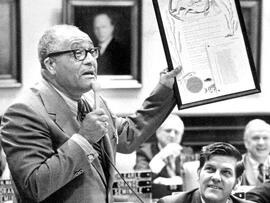
              Joseph “Joe” Lang Kershaw, Sr. (June 27, 1911–November 7, 1999) was the first African American elected to the Florida Legislature since Reconstruction. Born in Live Oak, Florida, he attended Florida A&M University in the 1930s, where he was involved in early campus life, including the beginnings of the football program, and pledged Kappa Alpha Psi. He later worked as a teacher in Miami-Dade County and as a janitor in the Florida Legislature before entering politics. Elected to the Florida House of Representatives in 1968, Kershaw served for fourteen years and chaired the Elections Committee, contributing to the establishment of the Florida Human Rights Commission.

              The Joseph Lang Kershaw, Sr. Collection documents Kershaw’s life, career, and contributions to Florida’s political and educational history. The collection contains materials related to his personal and academic background, as well as records reflecting his tenure in the Florida House of Representatives.

              Included are documents that highlight his legislative work, professional activities, and community involvement. The collection also contains materials pertaining to his family, including references to his father, A. J. Kershaw, as well as correspondence and documents related to colleagues and contemporaries such as Gwendolyn Cherry and Althea Gibson. Collectively, these records provide insight into Kershaw’s role as a pioneering African American legislator and his broader impact on civil rights and public service in Florida.

              Dr. William H. Gray, Jr. Papers
              Meek-Eaton Archival Collection AR_0007-_001-_004 · 1933 - 1972
              Parte de History of FAMU

              Location: AC.4B.3.1.1- AC.4B.3.4.6

              The William H. Gray Jr. Collection, preserved at the Meek-Eaton Black Archives Research Center and Museum at Florida A&M University, is a substantial and multifaceted body of primary source material documenting presidential leadership, institutional governance, and the broader landscape of Black higher education in the mid-twentieth-century American South. The collection is anchored in Gray’s presidency during the 1940s—a period shaped by World War II, postwar transition, and intensified struggles over educational equity within the rigid framework of Jim Crow segregation.

              The collection contains extensive correspondence, manuscripts, and administrative documents that illuminate Gray’s executive decision-making and strategic vision for Florida A&M University. Presidential and institutional correspondence reflects sustained engagement with state officials, accrediting bodies, faculty leadership, alumni, and external partners, revealing the political and financial negotiations required to sustain and advance a public historically Black institution. Manuscripts and policy drafts further document Gray’s intellectual approach to higher education leadership, institutional planning, and the articulation of Florida A&M University’s public mission.

              Faculty-related materials—including reports, evaluations, appointments, and governance documentation—provide insight into academic labor, professionalization, and the development of instructional and administrative standards during a period of institutional growth and constraint. Of particular significance are documents related to the Florida A&M University Hospital, which underscore the university’s role in professional training, public health, and community service, and highlight the intersection of education, medicine, and racial equity in segregated Florida.

              The collection also preserves records pertaining to major cultural and athletic initiatives, most notably the Orange Blossom Classic, situating the event as both a site of institutional visibility and a locus of African American cultural expression, economic impact, and alumni engagement. News clippings, printed programs, and ephemera document how Florida A&M University and its leadership were represented in regional and national media, offering scholars valuable perspectives on public perception, advocacy, and the university’s evolving national profile.

              Collectively, these materials document Gray’s efforts to expand campus infrastructure, stabilize governance, strengthen academic and professional programs, and position Florida A&M University as a flagship public HBCU amid persistent racial discrimination and structural underfunding. As an archival resource, the William H. Gray Jr. Collection supports advanced research in African American history, higher education administration, public policy, health and medical history, and cultural studies. It offers a critical lens through which to examine the intersections of race, leadership, and institutional resilience, while affirming Florida A&M University’s central role in the historical development of Black higher education in the United States.

              Sem título
              Gray, President William H.
              Meek-Eaton Archival Collection AR_0007-_001-_004-Box 07 · 1942 - 1956
              Parte de History of FAMU

              This file contains special correspondence dating from 1942 to 1956 generated during the presidency of Dr. William H. Gray, Jr., President of Florida Agricultural and Mechanical College. The materials are arranged alphabetically by correspondent, institution, or subject, and document communications between President Gray and other colleges and universities, medical professionals, funeral and mortuary service providers, civil rights advocates, business leaders, and educational administrators.

              The correspondence reflects President Gray’s engagement with a wide range of professional, institutional, and civic matters, including Black medical professionals and hospitals, Black-owned insurance companies, mortuary and ambulance services, career transitions, civil rights advocacy, transportation access, and inter-institutional collaboration with colleges and universities across the United States. Topics represented include professional advancement, institutional support, racial discrimination in transportation and public services, healthcare access, administrative leadership, and advocacy on behalf of African American communities during the postwar and early civil rights era.

              Collectively, these records provide significant insight into Florida A&M University’s presidential leadership and broader social influence during the mid-twentieth century. They illustrate Dr. Gray’s role as both an educational administrator and a civic advocate, highlighting the interconnected networks of Black professionals, institutions, and organizations navigating segregation, expanding professional opportunities, and advancing civil rights in the Jim Crow South and beyond.

              Gore, President George W.
              Meek-Eaton Archival Collection AR_0007-_001-_005-Box 23 · 1948 - 1982
              Parte de History of FAMU

              This file contains administrative papers and related records dating from 1950 to 1982 generated during the presidency and post-presidency of Florida Agricultural and Mechanical University (FAMU) President George W. Gore Jr. The materials are arranged alphabetically by subject title and reflect the institutional, administrative, and commemorative activities associated with Gore’s leadership and legacy.

              The papers include programs from President Gore’s funeral and memorial services, along with news clippings and newspaper articles documenting his death. The file also contains materials related to President Gore’s inauguration, including press releases, invitations, mailing lists, and housing arrangements. Additional materials include an interview with and about Dr. Gore conducted by Johnnie Que Blake, records related to FAMU ROTC, and news clippings concerning President Gore’s resignation. The file further includes the President’s Biennial Reports, FAMU publications addressing Gore’s administration, publications authored by Gore, and selected publications from The FAMCEAN (FAMU newspaper). Other materials document the FAMU School of Technology and student activities, including Charm Week. Of particular note are extensive files related to student activities and institutional response during the Martin Luther King Jr. riots, including news clippings, committee meeting records, and proposals for reopening the university and implementing campus improvements.

              Collectively, these papers provide insight into George W. Gore Jr.’s administration, public service, and enduring impact on Florida A&M University. The materials document moments of institutional celebration, crisis management, student activism, and commemoration, illustrating the complexities of university leadership and campus life during the mid- to late-twentieth century.

              Attorney Armstrong Purdee Family Collection
              Meek-Eaton Archival Collection MS_0014 · Coleção · 2015 - 2021

              Location: AC.8.A.2.2.4

              The Attorney Armstrong Purdee Collection documents the life, legacy, and historical significance of one of Jackson County’s earliest African American legal professionals. The collection contains photographs, commemorative materials, newspaper articles, publications, and digital resources that highlight Purdee’s professional accomplishments and the lasting impact of his work within the community.

              Materials include images of commemorative events, a photograph of Purdee’s gravesite, and newspaper coverage discussing his life and contributions. The collection also contains publications related to African American history in Jackson County, including a family reunion cookbook and a scrapbook documenting the legacy of African Americans in the region.

              In addition to printed materials, the collection includes a video link documenting a Black History Month program featuring the Jackson County NAACP and the Jackson County School Board. Together, these materials provide insight into community efforts to preserve the historical legacy of Attorney Armstrong Purdee and the broader history of African American leadership and civic engagement in Jackson County, Florida.

              The collection is arranged in a single box and organized by subject and material type, including commemorations, news articles, photographs, and publications related to Attorney Armstrong Purdee.

              Davis, Chester L. Sr.
              Meek-Eaton Archival Collection MS_0016-Box 01 · 1942 - 2017
              Parte de Chester L. Davis, Sr. Collection

              This box provides a focused view of Davis’s contributions within the broader historical context of African American military service during segregation, as well as the continued efforts to honor his legacy at the local, state, and national levels.

              The records within this box consist of a variety of formats, including correspondence, legislative recognitions, photographs, news articles, cassette tapes, and official service-related documentation. Early materials dating from the 1940s reflect Davis’s World War II service and include photographic and documentary evidence associated with the Congressional Gold Medal and other recognitions tied to the Montford Point Marines. These records highlight the significance of Davis’s role within one of the first groups of African Americans to serve in the United States Marine Corps.

              Correspondence files within the box provide insight into communication between Davis or his representatives and notable individuals and institutions, including the Marine Corps Archives and various public officials. Legislative recognitions from entities such as the United States Congress, the State of Florida, and the City of Quincy further emphasize the long-overdue acknowledgment of Davis’s service and sacrifice. Photographic materials document both his military-related achievements and commemorative events, including images of medals, awards, and presentations involving public figures and family members.

              Additional materials, including news articles and cassette tapes, contribute to a broader understanding of how Davis’s story has been preserved, interpreted, and shared over time. The inclusion of official service records and undated photographs provides further documentation of his military experience and personal life. Collectively, these materials illustrate the enduring impact of Davis’s service, as well as the evolving recognition of Montford Point Marines in American history.

              The records in Box 1 are arranged by subject and record type, with files organized alphabetically and materials within files arranged chronologically where applicable. This organization facilitates access while preserving the contextual relationships between documents. As a cohesive unit, Box 1 serves as a significant resource for researchers examining African American military history, World War II service, and the legacy of the Montford Point Marines.

              A. Philip Randolph Collection
              MS_0114

              Location: AC.1.B.2.1.1 - AC.1.B.2.1.6
              Asa Philip Randolph (1889–1979) was a pioneering labor leader and civil rights activist who played a major role in advancing equality for African Americans. Born in Florida, he organized the Brotherhood of Sleeping Car Porters in 1925, the first successful Black-led labor union, and became a leading voice for workers’ rights and racial justice.
              Randolph helped pressure the federal government to end discrimination in defense industries during World War II and was a key organizer of the 1963 March on Washington, where Dr. Martin Luther King Jr. delivered his famous “I Have a Dream” speech. His lifelong commitment to nonviolent protest, labor rights, and civil rights made him one of the most influential leaders of the 20th century.

              The Rosewood Massacre Papers
              Meek-Eaton Archival Collection MS_0001 · Coleção · 1900 - 1996

              Location: AC.6.B.2.4.7-AC.6.B.3.4.4

              The Rosewood Massacre was a racially motivated attack on the predominantly African American town of Rosewood, Florida, in January 1923. Sparked by false accusations and fueled by racial tensions under Jim Crow segregation, white mobs destroyed homes, churches, and businesses, forcing residents to flee and permanently abandon the town. For decades, the event remained largely suppressed in public memory until renewed attention in 1982 by journalist Gary Moore prompted survivors and descendants to seek justice. Their efforts led to a state investigation and compensation legislation, marking one of the first instances of reparations for racial violence in the United States.

              Archival Description:
              The Rosewood Massacre Papers Collection spans 35 boxes with materials dating from 1900 to 1996 and documents the historical, legal, and commemorative efforts surrounding the 1923 massacre. The collection includes narrative reports, multiple versions of documented histories, survivor affidavits, administrative files, correspondence, interview transcripts, handwritten notes, vital records such as birth certificates, census records including the 1920 U.S. Census, property records such as Levy County deed indexes, and materials related to claims verification.

              Folders within the collection contain complete narrative reports and reproduced copies used for research, review, and preservation; affidavits from survivors including Bertha Fagin, Ivory T. Fuller, Vera G. Goins Hamilton, Thelma Hawkins, and Dorothy G. Hosey; correspondence from agencies such as the Florida State Department of Health and Rehabilitative Services and Offices of Vital Statistics; as well as administrative communications, genealogical documentation, and evidentiary records supporting compensation claims.

              Collectively, these materials document both the historical reconstruction of the Rosewood Massacre and the legal and administrative processes undertaken to verify survivors, establish lineage, and secure restitution.