Mostrando 35 resultados

Descripción archivística
11 resultados con objetos digitales Muestra los resultados con objetos digitales
Charles Hamilton Collection
Meek-Eaton Archival Collection MS_0011 · Colección

Location: AC.8.B.2.4.3

Mr. Charles Hamilton was an African-American landowner, farmer, and businessman who lived
in Marion County, Florida, during the late 1800s and turn of the twentieth century. Marion
The county is located in Central Florida. According to information from the 1900 US Census, the
Hamilton Family patriarch, listed as Charly Hamilton, was born during slavery in 1853 and
possibly migrated to Florida from South Carolina after the Civil War. Charly and his wife
Georgia had three sons, Richard, Charlie, and Jonas, and two daughters, Estelle and Texella.
Hamilton and his descendants also owned property and conducted business in neighboring Levy
County.

Arthur L. Kidd Collection
Meek-Eaton Archival Collection MS_0013 · Colección · 1934 - 1967

Location: AC.2.B.3.2.2- AC.2.B.3.2.5

This collection consists of personal papers from Florida A&M University’s Arthur L. Kidd. Kidd, a native of Pennsylvania, earned a B.A. degree in 1924 from the University of Michigan, and in 1929, a Masters of Arts degree from Columbia University. Kidd also did additional studying at the University of Iowa, Columbia University, and New York University. He began his teaching career at Tuskegee Institute in 1924 before accepting a position at Florida A&M College (FAMCEE) in 1925 as Principal of the High School. Kidd worked at FAMCEE until 1944. During his nineteen years of service to the college, Kidd worked in numerous positions, including: Head of the Department of History, Acting Director of the Extension Division, Acting Dean for the College of Arts and Sciences and College Registrar. In October 1944, Kidd left his position at FAMCEE to work with the United Nations Relief and Rehabilitation Administration, where he worked in various capacities in Washington, D.C., and abroad in locations including France, Germany, and Holland. He returned to the United States in 1950 and worked for a year at Maryland State College before accepting a second appointment at FAMCEE in 1951 as Director of the Division of Social Studies. Upon the college reaching university status in 1954, in the academic re-organization, Kidd consequently became the Associate Dean of the College of Arts and Sciences. Until 1969, he served FAMU in various capacities, including director of institutional studies and director of university administrative planning.

The material type in this collection were mainly magazines, news articles, and news clippings from 1949-19687 that followed local and national events affecting Negro people and occurrences impacting their lives. The records of this collection are especially important and informative in that they as resources that document firsthand the many historic events that occurred during the American Negro Civil Rights Years. Most of the records document the passing of school integration and public desegregation legislation, mass boycotts, sit-ins, and other forms of protest, as well as the brutal, nationwide social turbulence that accompanied this period. Additionally, a small amount of materials related to Kidd's instructional duties at FAMU are included.

Biographical data and inclusive subjects were acquired from Murell Dawson circa 2002.

Joseph Lang Kershaw, Sr. Collection
Meek-Eaton Archival Collection MS_0009 · Colección

Location: AC.8.B.1.1.1-AC.8.B.1.1.3

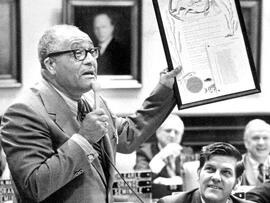
Joseph “Joe” Lang Kershaw, Sr. (June 27, 1911–November 7, 1999) was the first African American elected to the Florida Legislature since Reconstruction. Born in Live Oak, Florida, he attended Florida A&M University in the 1930s, where he was involved in early campus life, including the beginnings of the football program, and pledged Kappa Alpha Psi. He later worked as a teacher in Miami-Dade County and as a janitor in the Florida Legislature before entering politics. Elected to the Florida House of Representatives in 1968, Kershaw served for fourteen years and chaired the Elections Committee, contributing to the establishment of the Florida Human Rights Commission.

The Joseph Lang Kershaw, Sr. Collection documents Kershaw’s life, career, and contributions to Florida’s political and educational history. The collection contains materials related to his personal and academic background, as well as records reflecting his tenure in the Florida House of Representatives.

Included are documents that highlight his legislative work, professional activities, and community involvement. The collection also contains materials pertaining to his family, including references to his father, A. J. Kershaw, as well as correspondence and documents related to colleagues and contemporaries such as Gwendolyn Cherry and Althea Gibson. Collectively, these records provide insight into Kershaw’s role as a pioneering African American legislator and his broader impact on civil rights and public service in Florida.

History of FAMU
Meek-Eaton Archival Collection AR_0007

For more than 130 years, Florida A&M University has served the citizens of the State of Florida and the nation by providing preeminent educational programs...programs that were the building blocks of a legacy of academic excellence with caring. FAMU, “Florida’s Opportunity University,” is committed to meeting the challenges and needs of future generations.

In 1884, Thomas Van Renssaler Gibbs, a Duval County educator, was elected to the Florida legislature. Although his political career ended abruptly because of the resurgence of segregation, Representative Gibbs successfully orchestrated the passage of House Bill 133 in 1884. This bill established a white normal school in Gainesville and a school for African Americans in Jacksonville. The bill passed, creating both institutions; however, the state decided to relocate the school for African Americans to Tallahassee.

After the bill’s passage, FAMU was founded on October 3, 1887. It began classes with 15 students and two (2) instructors. Thomas DeSaille Tucker (1887-1901), an attorney from Pensacola, was chosen as the first president. Former State Representative Gibbs joined Mr. Tucker as the second faculty member.

In 1891, the College received $7,500 under the Second Morrill Act for agricultural and mechanical arts education. The State Normal College for Colored Students became Florida’s land grant institution for African Americans, and its name was changed to the State Normal and Industrial College for Colored Students.

In 1905, the management of the College was transferred from the Board of Education to the Board of Control. This significant event officially designated the College as an institution of higher education.
In 1909 the name was changed from The State Normal College for Colored Students to Florida Agricultural and Mechanical College for Negroes (FAMC). The following year, with an enrollment of 317 students, the college awarded its first degrees.

President Nathan B. Young (1901-1923) directed the growth of the College to a four-year degree-granting institution, despite limited resources, offering the Bachelor of Science degree in education, science, home economics, agriculture, and mechanical arts.

Under the administration of John Robert Edward Lee Sr. (1924-1944), the College acquired much of the physical and academic image it has today. More faculty were hired, courses were upgraded, and accreditation was received from several state agencies. By the end of Lee’s term, FAMC had 812 students and 122 staff members.

In 1949, under William H. Gray Jr. (1944-1949), expansion and reorganization continued. The College obtained an Army ROTC unit, and student enrollment grew to more than 2,000.

D. E. Williams Collection
Meek-Eaton Archival Collection MS_0123

Location: AC.8.A.3.3.1 - AC.8.A.3.4.4

DeWitt Everett Williams served as the State Agent of Negro Schools in Florida from 1927 to 1962 under the Florida Department of Education. In this role, he was responsible for overseeing and supporting the development of African American education during the era of segregation. His work placed him in direct contact with schools across the state, documenting their conditions, operations, and communities during a critical period in the history of public education in Florida.

The D. E. Williams Collection consists of six boxes of materials documenting African American education in Florida during the Jim Crow era. The collection primarily contains photographs of segregated African American schools across the state, reflecting both rural and urban educational environments. These images provide visual documentation of school buildings, classrooms, students, and faculty, offering insight into the conditions and experiences within segregated educational systems.

The photographs are arranged alphabetically by county, facilitating geographic access and highlighting regional differences in school infrastructure and resources. Collectively, the collection serves as an important resource for understanding the historical landscape of African American education in Florida and the broader social and institutional context of segregation in the twentieth century.

Joe Nash Collection
Meek-Eaton Archival Collection MS_0019 · Colección

Location: AC.8.B.4.4.1 - AC.8.B.4.7.1

The Joe Nash Collection documents a range of cultural, social, and media-related materials reflecting aspects of public life and community engagement. The collection includes advertisements, books, magazines, news clippings, newsletters, photographs, programs, and other publications such as theatrical playbills and posters.

These materials provide insight into entertainment, communication, and cultural expression across various contexts. The presence of theatrical playbills, programs, and posters highlights performance and artistic activity, while magazines, newsletters, and news clippings capture contemporary events, trends, and public discourse.

Photographs within the collection offer visual documentation that complements the printed materials, enhancing its research value. Collectively, the Joe Nash Collection preserves a diverse array of media formats, serving as a resource for understanding cultural production and the ways information and experiences were shared within communities.

Bishop David Henry Sims Collection
Meek-Eaton Archival Collection MS_0023 · Colección · 1931 - 1938

Location: AC.8.A.2.4.3
Bishop David Henry Sims was a prominent African American religious leader, educator, and administrator in the African Methodist Episcopal (A.M.E.) Church during the early twentieth century. Born in 1889 in Talladega, Alabama, he was the son of Reverend Felix Rice Sims, a well-educated minister who greatly influenced his early life and commitment to education and faith. Sims pursued higher education at several institutions, including Livingstone College, Oberlin College, and Yale University, where he completed advanced theological training.

Throughout his career, Sims held numerous leadership roles in both religious and academic settings. He served as a professor of education and later as vice president at Morris Brown College in Atlanta, Georgia. His work within the A.M.E. Church included pastoral leadership, administrative service, and participation in major church conferences. In 1932, he was elected Bishop in the A.M.E. Church, marking a significant achievement in his career.

Sims was also involved in broader social and political efforts, including service on commissions related to education and public affairs. His work extended internationally, particularly in South Africa, where he contributed to missionary and educational initiatives. His life and career reflect a deep commitment to religious leadership, education, and the advancement of African American communities during a period of significant social change.

The majority of the records in this collection are handwritten letters from Bishop Sims to his sister, Mrs. Miriam Sims-Tooke. These letters provide a detailed and intimate account of his daily life, thoughts, and activities, particularly during the period in which he was working in South Africa. Through this correspondence, the collection highlights Sims’ involvement in missionary work, his observations of social and cultural conditions abroad, and his ongoing connection to family in the United States.

In addition to correspondence, the collection includes greeting cards and photographs that further document Sims’ personal and professional networks. These materials complement the letters by providing visual and contextual evidence of his life and relationships during this period.

The collection was processed in 1985 and is arranged at the file level, reflecting a coherent grouping of personal papers centered on correspondence and related materials. Collectively, the Bishop David Henry Sims Collection offers a unique perspective on the experiences of an African American religious leader working in an international context, while also shedding light on familial bonds, missionary efforts, and transnational connections within the African diaspora during the early twentieth century.

Meek-Eaton Archival Collection MS_0014 · Colección · 2015 - 2021

Location: AC.8.A.2.2.4

The Attorney Armstrong Purdee Collection documents the life, legacy, and historical significance of one of Jackson County’s earliest African American legal professionals. The collection contains photographs, commemorative materials, newspaper articles, publications, and digital resources that highlight Purdee’s professional accomplishments and the lasting impact of his work within the community.

Materials include images of commemorative events, a photograph of Purdee’s gravesite, and newspaper coverage discussing his life and contributions. The collection also contains publications related to African American history in Jackson County, including a family reunion cookbook and a scrapbook documenting the legacy of African Americans in the region.

In addition to printed materials, the collection includes a video link documenting a Black History Month program featuring the Jackson County NAACP and the Jackson County School Board. Together, these materials provide insight into community efforts to preserve the historical legacy of Attorney Armstrong Purdee and the broader history of African American leadership and civic engagement in Jackson County, Florida.

The collection is arranged in a single box and organized by subject and material type, including commemorations, news articles, photographs, and publications related to Attorney Armstrong Purdee.

Reverend Elvis W. Spearman Collection
Meek-Eaton Archival Collection MS_0017 · Colección

Location: AC.3.A.3.5.6

The Reverend Elvis W. Spearman Collection consists of one box of materials documenting the professional and spiritual life of Rev. Elvis W. Spearman. Spearman served as postmaster at Florida A&M University until his retirement in 1964 and also held the role of hospital chaplain from 1955 to 1964. He earned an A.B. degree from Legal College and pursued additional studies at Florida A&M University, the University of Chicago, and Deering Community Center.

The collection primarily contains speeches and sermons delivered by Rev. Spearman, reflecting his work in ministry and his engagement with religious and community life. Most of the materials are undated, though they provide valuable insight into his theological perspectives, public speaking, and role as a spiritual leader.

In addition to sermons, the collection includes a small number of documents related to his administrative duties at Florida A&M University. Collectively, these materials offer a glimpse into Spearman’s dual roles in institutional service and religious leadership, highlighting his contributions to the university and its broader community.